What Is CRISPR-Cas9?

In this story
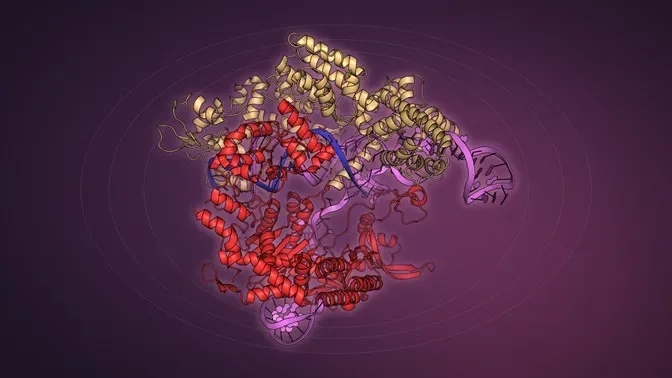
CRISPR-Cas9 is a gene-editing tool that uses a guide RNA to bring the Cas9 protein to a region of DNA. Cas9 can cut the DNA there. The cell’s response to that cut helps determine the resulting change. Researchers use this system to study what genes do, and doctors now have an approved treatment that uses it to edit blood-forming stem cells.
The distinction between finding, cutting, and changing DNA explains both the technology’s promise and its limits. A guide can direct Cas9 to a region of interest. Whether the resulting change improves health is a separate question that scientists have to answer in studies of a specific treatment.
What does CRISPR-Cas9 stand for?
CRISPR stands for clustered regularly interspaced short palindromic repeats. The name describes a pattern in bacterial DNA that is part of a naturally occurring defense system. Cas9 is a CRISPR-associated protein that cuts DNA. In the editing tool, RNA supplies the targeting information and Cas9 does the cutting.
The 2012 study by Martin Jinek and colleagues showed that RNA could program Cas9 to cut DNA in a controlled experiment. That finding provided the basis for the editing tool. Studies of what happens in cells, and later in people, were needed to establish what the tool could do in those settings.
Related Posts:
What Is Computational Biology?
How does CRISPR-Cas9 edit DNA?
The guide locates a region and Cas9 makes the cut
The guide RNA can pair with a corresponding stretch of DNA. When the molecular conditions for recognition are met, standard Cas9 can cut across both strands. The familiar “molecular scissors” analogy describes the cut. The guide accounts for where the scissors go, and the cell supplies the repair machinery.
The cell’s repair can produce different outcomes
A cell may rejoin the DNA ends with a small piece added or missing. An insertion or deletion can disrupt a gene or alter how nearby DNA regulates a gene. Some editing approaches aim for a specific sequence change by making use of the cell’s ability to copy from a repair template. The result depends on the edit and the biological setting.
These outcomes explain why researchers distinguish an intended change from an observed change. They can ask whether the DNA changed where expected, whether that change altered gene activity, and whether the changed activity affected the behavior of a cell. Each question calls for its own evidence.
What can a lab result show?
A study in cells can show how a change affects that model under the conditions tested. For example, a model can help researchers examine whether an edit changes production of a protein. It takes separate evidence to show that the same change benefits people. Our explainer on organoid intelligence describes another setting where a laboratory model answers a narrower question than the system it represents.
How Casgevy uses CRISPR-Cas9
Casgevy, also known as exa-cel, is a treatment made from a patient’s own blood-forming stem cells. Medical teams collect the cells, have them edited outside the body, and return them by infusion after conditioning chemotherapy. Editing outside the body is called ex vivo editing. The edited cells can then take hold in the bone marrow and produce new blood cells.
The edit changes a DNA region that helps regulate production of fetal hemoglobin, the form of hemoglobin that predominates before birth. Raising fetal hemoglobin helps compensate for the effects of the inherited blood disorder. The underlying disease-causing variant remains in the patient’s DNA. This is an example of treating a disease by changing gene regulation.
The FDA first approved Casgevy in 2023. Its July 2026 US label covers patients ages 2 and older with sickle cell disease and recurrent vaso-occlusive crises, or with transfusion-dependent beta thalassemia. For sickle cell disease, the pivotal trial measured a period without severe crises. For beta thalassemia, it measured whether patients could go a sustained period without red blood cell transfusions.
What does 93.5% mean in the sickle cell trial?
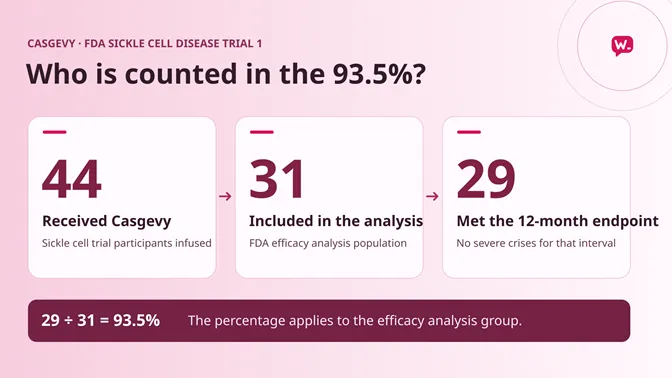
In the label’s trial of patients ages 12 and older, 63 enrolled and 44 received Casgevy. The FDA label reports that 29 of the 31 patients in the efficacy analysis went at least 12 consecutive months without a trial-defined severe vaso-occlusive crisis within the first 24 months after infusion. Dividing 29 by 31 gives 93.5% after rounding. The label counts one participant with less than 16 months of follow-up as a nonresponder.
The pediatric evidence has a different denominator. The same label reports that eight of eight children in the efficacy analysis of a separate sickle cell trial met the 12-month endpoint. Those eight children were 5 to 11 years old. The broader approved age range and the age of the children in that analysis answer different questions. Reading the age range alongside the outcome keeps a small study from sounding like a result measured across every approved age.
How to read a CRISPR research headline
A headline saying “CRISPR worked in 94% of patients” leaves out the outcome, the group, and the time period. Those details change the meaning. In the Casgevy example, the proportion describes a specific clinical endpoint in a defined analysis population. It cannot tell a reader how long an individual patient will benefit or how likely that person is to experience a complication.
Question to ask | What to look for | How it applies to Casgevy |
What did the study measure? | A change in DNA, a biomarker, or a clinical outcome. | The FDA label reports twelve consecutive months without a severe crisis for its main sickle cell outcome. |
Who was counted? | Enrollment, treatment, follow-up, and analysis counts. | The FDA label gives 63 enrolled, 44 infused, and 31 in the efficacy analysis for Trial 1. |
What was the comparison? | A concurrent control group, each person’s baseline, or a statistical benchmark. | The trial was single-arm. The label reports outcomes for the treated group. |
How long did it last? | The observation window, the minimum follow-up, and any later observations. | The qualifying twelve months had to occur within the first 24 months after infusion. |
The same reading habit applies before a therapy reaches clinical testing. A sensor signal or lab measurement may be informative without establishing a health outcome. Our guide to how biosensors work describes the distinction between what an instrument detects and what that result can tell you. If a claim comes from a summary, check it against the underlying source before repeating the number.
Compare results only after checking how each study defines its endpoint. A trial may count severe pain crises that meet specific criteria while a patient may also experience pain that falls outside that definition. The headline number describes the study endpoint. A fuller picture includes other symptoms, hospitalizations, complications, and quality of life.
What are the risks and limitations of CRISPR-Cas9?
An unintended change at another region of DNA is called an off-target edit. An unintended outcome can also occur at the intended region because cells can repair a cut in different ways. In a therapy, researchers also have to account for which cells receive the edit and how long the effect persists. The FDA label says the risk of unintended off-target editing from Casgevy cannot be ruled out.
Treatment risks also extend beyond the edit. Casgevy requires intensive conditioning chemotherapy before the infusion. The label warns about delayed platelet recovery and the a risk that infection-fighting white blood cells may fail to recover after infusion. Blood counts and adverse events are part of the evidence, alongside how well the therapy controls the disease.
Somatic and heritable editing raise different questions
Casgevy edits blood-forming cells for the person receiving treatment. This is somatic editing, which changes cells of the patient’s body. Heritable editing involves changes that could pass to future generations. WHO considers these categories separately in its governance recommendations because their consequences and oversight needs differ.
A study can answer whether an edit accomplished a biological goal. Decisions about clinical use require evidence about benefits and harms, who was studied, and how patients are followed. Heritable applications add questions about future generations, including who can consent to a change that may affect people who have yet to be born.
Does an FDA approval apply to all CRISPR therapies?
Approval applies to a named product and the use described in its label. Casgevy’s results establish evidence for specific blood disorders and a specific treatment process. A different CRISPR therapy might work in another tissue, use a different way to reach cells, or measure a different outcome. Each of those changes calls for its own clinical evidence.
What is the difference between ex vivo and in vivo editing?
Ex vivo editing takes place in cells outside the body. An edited cell product can then be given to the patient, as in Casgevy. In vivo editing takes place inside the body. A study of an in vivo treatment has to show that the treatment reaches the relevant cells and produces a benefit there. The place where editing happens matters when comparing which results and risks carry over between studies.
Sources
1. National Human Genome Research Institute — How genome editing works
2. Jinek et al. — The 2012 study of RNA-programmed Cas9 in Science
3. US Food and Drug Administration — Casgevy prescribing information, revised July 2026
4. World Health Organization — Human genome editing recommendations
Keep reading


Reinforcement Learning Explained With a Worked Example
Reinforcement learning is a way to train an agent to choose actions that maximize expected cumulative reward. The agent interacts with an environment, receives...

What Is Biocomputing? How Biological Computers Work, Examples and Applications
In 2022, researchers connected living human and mouse neurons to a simulated Pong game and reported that the cultures changed their behavior with structured fee...


Gemini 4 Neon vs GPT-6.2 Sol: Speed Evidence and Three Practical Tests
Sol looks promising for turnaround, while Neon merits a trial when reasoning errors cause rework. Compare the published evidence and repeat three practical tests on your own work.