Organoid Intelligence Explained

In this story
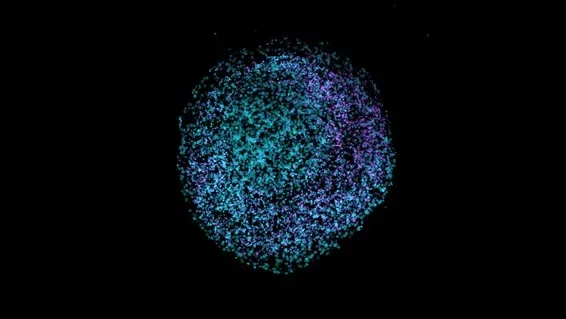
Organoid intelligence is a field of research that connects lab-grown neural tissue to electronics and software. Researchers use the resulting systems to study how living networks respond, change with experience, and contribute to narrowly defined computing tasks. Early experiments have reported signals relevant to learning and memory and used organoid activity as part of a system that classified speech recordings.
The evidence depends on the experiment. A change in electrical activity answers a question about the tissue. A classification score tells you how the entire system did on a particular task. The term “intelligence” names a research program that includes both kinds of work. The original 2023 organoid intelligence proposal.
What is a brain organoid?
A brain organoid is a three-dimensional tissue model that captures selected features of developing nervous tissue. Researchers can derive these models from human pluripotent stem cells, which can give rise to many cell types. Neural cells in an organoid can form connections and generate electrical activity. Its value comes from the particular biological features it reproduces, so the model you choose depends on the question you want to study.
For example, a team studying how a neural network changes over time might record patterns of activity. A computing team might use those patterns to help distinguish one input from another. The same tissue can be useful in both studies, while each team needs its own controls and measures of success. Johns Hopkins’ Organoid Intelligence research overview.
Read more:
How organoid biocomputing works
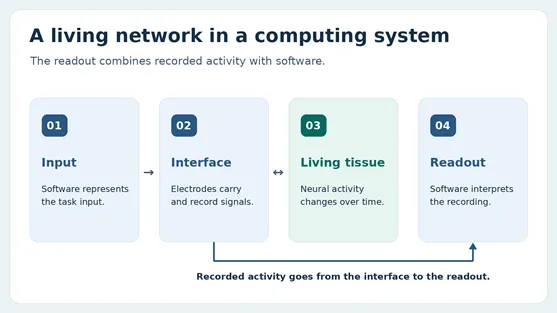
An organoid computing setup divides the work among several components. A computer represents the input. An interface lets researchers send signals to the tissue and record its activity. A computer then analyzes the recording and can translate it into an output such as a class label. The result reflects the combined system. It helps to identify which steps the living network handles and which steps the software handles.
An electrode records an electrical signal. A classifier interprets a pattern in that signal. Our biosensors guide explains a related distinction between the signal a device captures and the result it reports.
What reservoir computing means
A reservoir is a system whose changing internal activity transforms an input. In organoid reservoir computing, the living network provides that changing activity. A readout, usually implemented in software, learns how to interpret the measured patterns for a task. If two inputs leave distinct patterns, the readout may be able to tell them apart. The experiment can then ask how much the tissue contributed compared with a suitable nonliving or software-only baseline.
What researchers mean by learning
Learning can refer to an improvement in task performance or to a lasting change in the tissue’s responses. Plasticity is the capacity for those responses or connections to change. Look at how the study defines each term. If a classifier improved after software training, check what evidence links the change to the tissue. If the researchers measured plasticity, look for how they separated a persistent change from activity that fluctuates naturally.
In this field, “intelligence” is tied to specific tasks and properties of neural tissue. In discussions of AI systems, artificial superintelligence describes a hypothetical level of capability across many domains. Reading the two terms in their own context helps make sense of claims about the scope of an experiment. Our guide to artificial superintelligence.
What organoid intelligence experiments have shown
Study | What the researchers measured | How far the result reaches |
DishBrain, 2022 | Performance in a simulated Pong-like game using cultured neurons and software feedback. | Task adaptation in a system with two-dimensional cultures. |
Brainoware, 2023 | A hybrid system with a 3D organoid performed a speech classification and a numerical prediction task. | The organoid was part of a reservoir computing demonstration. |
Johns Hopkins–led study, 2025 | Neural activity and measures associated with synaptic plasticity in human neural organoids. | Evidence of mechanisms relevant to learning and memory. |
DishBrain used a layer of neurons
Kagan and colleagues connected cultured human or rodent neurons to a simulation inspired by Pong. Their system used a layer of cells and software that mapped the recorded activity to paddle movement. The team reported changes in performance under structured feedback. Popular accounts often group DishBrain with organoid computers because it uses living neural cells for a task. The tissue format is important when comparing it with experiments on three-dimensional organoids. The DishBrain study in Neuron.
DishBrain illustrates a closed loop. The recorded activity affected the paddle, and events in the game changed the signals sent back to the cells. In a classification experiment, the software can instead assign a label from a recorded response without feeding that label back into the tissue. This distinction helps explain why the two setups measure different kinds of performance.
Brainoware used an organoid as a reservoir
Cai and colleagues connected a three-dimensional brain organoid to an electrode interface and used its responses in a reservoir computing system. The paper describes a limited speech classification task and prediction for a nonlinear equation. When you read that Brainoware recognized speech, look at the task’s labels and input set. The experiment reports performance for the combined tissue, hardware, and software on those defined inputs. The Brainoware paper and abstract.
The 2025 study looked at mechanisms of learning and memory
Alam El Din and colleagues examined network activity and synaptic plasticity in human neural organoids. Their results address whether the tissue can exhibit biological processes that researchers associate with learning and memory. A study of those processes has a different outcome measure from a study scored by correct predictions. Read the measurements before comparing what the authors call learning. The 2025 study in Communications Biology.
How to evaluate an organoid computing claim
Suppose a research team says a hybrid system recognized 72 of 100 recordings. In this invented example, 60 recordings belong to the most common class, so a system that always picks that class gets 60 right. The hybrid system also gets compared with a software-only version that scores 69 using the same evaluation set. The choice of baseline changes how you interpret the headline number.
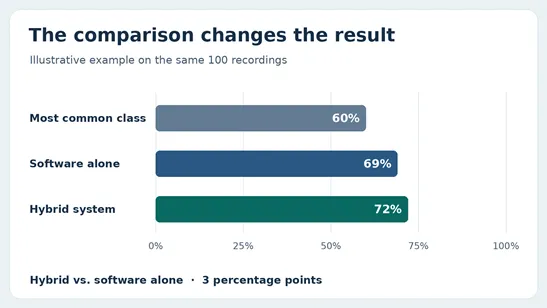
The hybrid system is 12 percentage points ahead of the majority-class guess and three points ahead of software alone. A three-point gap on 100 recordings can be worth investigating. To tell whether it’s reliable, you’d want to know whether the same recordings were missed, how much results varied across runs, and whether the improvement held with different organoids.
Questions to ask when you read the paper
1. Identify the actual output. Check whether the study reports a classification score, a change in electrical activity, or the behavior of a simulated system. See whether the headline uses the same measure.
2. Follow the role of the software. Look for a comparison that holds the inputs, data split, and scoring procedure constant. Check which part of the readout was trained and when the researchers evaluated it on data reserved for testing.
3. Look for repeatability. A large number of recordings can all come from the same tissue sample. Find out how many independently prepared samples were studied and whether another group reproduced the result. For help checking whether a summary supports the claim, use our source-check exercise.
Where the research could be useful
One near-term goal is to use human neural tissue models to study development and disease. A researcher could ask whether a disease model shows different patterns of network activity or whether a candidate treatment changes a measurable feature. To be useful in that setting, the measurement needs to be reliable across samples and relevant to the biological question. A model’s value depends on which features of human tissue it reproduces. Johns Hopkins’ research overview.
Computing research has a different set of demands. Groups need ways to compare output quality, stability, and performance across systems. In 2024, FinalSpark researchers described a remotely accessible platform for recording and studying organoids. Shared access can make experiments easier to compare when teams agree on what to measure and how to report it. A claim about computing efficiency also needs a defined comparison that accounts for the tissue support system, instrumentation, and software. FinalSpark’s Neuroplatform paper.
Consciousness, consent, and oversight
Electrical activity and task performance are observable. Conscious experience is a separate question, and the evidence discussed here concerns signals, tissue responses, and task scores. The National Academies noted that neural organoids represent limited parts of brain organization and that assessing capacities such as consciousness poses scientific challenges. National Academies’ assessment.
Questions about consent arise regardless of how complex the tissue becomes. A donor should have clear information about how their cells may be used, shared, or stored. Research institutions also have to consider whether changes in the complexity or use of a model call for additional review. The ISSCR stem cell research guidelines provide a framework for consent and oversight.
A strong next result would show that independent teams can use comparable systems to reproduce a specific effect. For computing, that means testing a defined task against a well-matched baseline. For biology, it means tracing a reproducible signal to a clearly defined feature of the tissue. Those are claims readers can check as the field develops.
Keep reading


How to Get Your Business on ChatGPT
Claim or add your business in ChatGPT Business Hub, complete verification, and use Insights to see how customers discover your business.


How Quantum Dots Turn Size Into Color
Quantum dots are tiny regions of semiconductor that confine electrons in all three dimensions. In a TV, they typically take the form of nanocrystals just a few...
Quantum Computing Basics for Beginners
A quantum computer uses qubits to represent information. Its gates change how likely different outcomes are when you measure the qubits. Some algorithms use tho...