Quantum Superposition Explained With One Qubit and Two Slits

In this story

Quantum superposition is a way of combining possible states of a quantum system using quantities called amplitudes. When you measure the system a particular way, those amplitudes determine the probabilities of the outcomes. Change how you measure, and the amplitudes can reinforce or cancel each other. That interference is what makes a superposition different from ordinary uncertainty about a hidden outcome.
Imagine two qubits that both give 0 or 1 with equal odds in the usual readout. A second kind of test can distinguish the preparations perfectly in an ideal experiment. One always gives 0 after a final operation and the other always gives 1. The difference was in the relative phase of the amplitudes, even though the first readout could never reveal it.
What does superposition mean in simple terms?
Think of two waves meeting. If their peaks line up, they reinforce. If a peak meets an equally deep trough, the waves cancel at that point. Quantum amplitudes also combine before you calculate probabilities. The wave analogy describes how the numbers combine. Each individual measurement still records one outcome, such as a single spot on a screen or a single bit from a qubit.
Which states make up a superposition depends on the basis, the set of reference states used to describe or measure the system. A qubit can give a definite answer in one basis and have two possible results in another. Changing the basis you use to describe a state leaves the state itself unchanged. Choosing a measurement basis changes the question you ask of that state.
Read more:
A visual test for quantum superposition
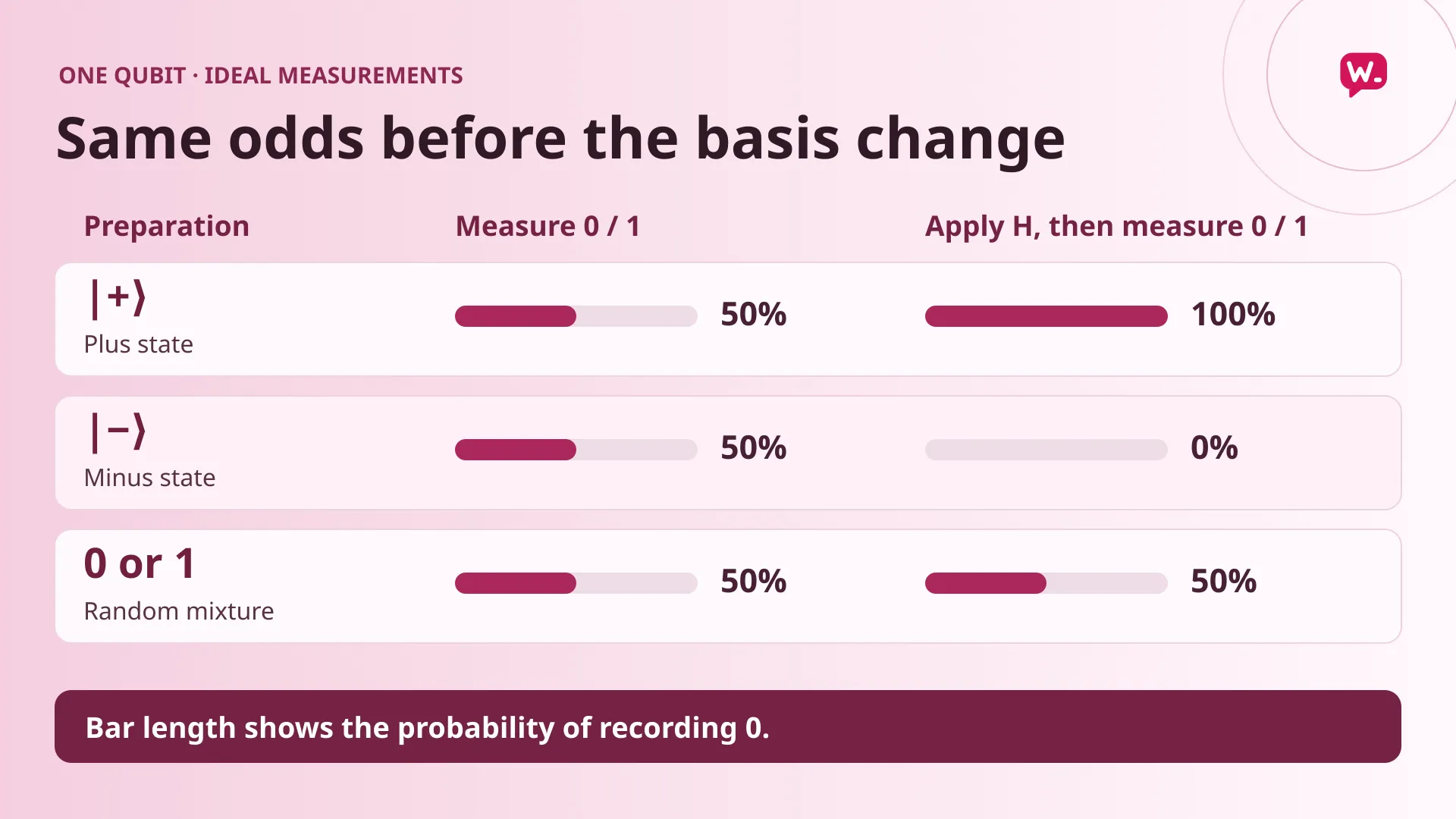
Consider three preparations. The plus state, written |+⟩, gives the 0 and 1 components amplitudes of equal size and the same sign. The minus state, |−⟩, has the same two sizes with opposite signs. In the third preparation, a fair coin determines whether the device prepares a definite 0 or a definite 1. That creates a classical mixture. A 0-or-1 readout alone gives the same statistics for all three.
Why a phase change can send the result the other way
Prepare a fresh batch of each state for the second test. Apply an operation called a Hadamard gate, written H, before measuring 0 or 1. The gate recombines the two amplitudes. For the plus state they add in the 0 output and cancel in the 1 output. For the minus state the cancellation occurs in the 0 output. Changing one sign changes which result appears.
The coin-selected mixture remains a 50–50 split after H. Half the runs start with a definite 0 and half with a definite 1. Applying H to either of those starting states produces equal odds in the final readout. Averaging two 50–50 distributions still gives 50–50. Use separate runs for each test so the first measurement does not remove the phase information before the second test.
Try the calculation with one qubit
The amplitude describes a contribution to the state. To get the probability of a particular result in the chosen basis, square the amplitude’s magnitude. For |+⟩ and |−⟩, the magnitudes of both amplitudes are 1/√2. Squaring that number gives 1/2. The plus and minus signs disappear when you calculate those direct readout probabilities.
For the H test, use a and b for the original amplitudes of 0 and 1. The gate gives output 0 the amplitude (a + b)/√2 and output 1 the amplitude (a − b)/√2. With a and b both equal to 1/√2, the outputs are 1 and 0. If b is −1/√2, the outputs are 0 and 1. Squaring the final amplitudes gives the percentages below. These are ideal predictions.
Preparation | Measure 0 or 1 directly | Apply H, then measure 0 or 1 |
Plus state |+⟩ | 50% 0, 50% 1 | 100% 0, 0% 1 |
Minus state |−⟩ | 50% 0, 50% 1 | 0% 0, 100% 1 |
Fair mixture of 0 and 1 | 50% 0, 50% 1 | 50% 0, 50% 1 |
Check the prediction on a circuit simulator
Start with a qubit in 0. Put H before the readout to prepare and measure the plus state. On a separate circuit, put H then Z before the readout. The Z gate changes the sign of the 1 component and prepares the minus state. Both circuits should give roughly equal counts when you sample them many times. Then make a copy of each circuit and add one more H just before measurement. In an ideal simulator, those copies return 0 and 1 respectively on every run. The setup is small enough to predict by hand before you look at the results.
What changes when you measure a qubit?
An ideal 0-or-1 measurement of either superposition returns one bit and leaves the qubit in the corresponding basis state. Measure that same qubit again in the same basis right away and the result repeats, assuming nothing has disturbed it. To estimate the original probabilities, you prepare it again for each trial. In textbooks this update of the state after measurement is often called collapse.
The H test is a way to measure in the plus/minus basis using a 0-or-1 readout. The transformation maps the plus state to 0 and the minus state to 1, letting familiar electronics report which state the test found. If you are new to circuit diagrams, our quantum computing basics guide explains how qubits, gates, and measurements fit together.
The signs in this example give two easy-to-calculate phases. In general, a relative phase can vary continuously. Multiplying the entire state by the same phase has no effect on measurement probabilities. Changing the phase of one component relative to another can change interference.
What the double-slit experiment shows
A double-slit experiment sends particles toward a barrier with two openings. A detector records a single landing position each time an electron arrives. In the 2013 experiment by Roger Bach and colleagues, the researchers recorded those individual events and watched an interference pattern build up. They also measured the diffraction patterns with one slit open at a time. The pattern with both slits open depends on how the two path amplitudes combine.
In a related two-path experiment with photons, Vincent Jacques and colleagues used an interferometer, a device that can bring two paths back together. With the paths recombined, the team observed interference. In the configuration that measured the path, it obtained path information. This is the same kind of choice as the two qubit tests. The apparatus determines which information the readout can reveal.
How the environment can erase visible interference
When a system interacts with its surroundings, information about its state can spread into those surroundings. If the two paths leave distinguishable records, the interference you can observe in the particle alone is reduced. This loss of accessible phase relationships is called decoherence. Trapped-ion researchers have measured how coupling to a controlled environment changes the rate of decoherence.
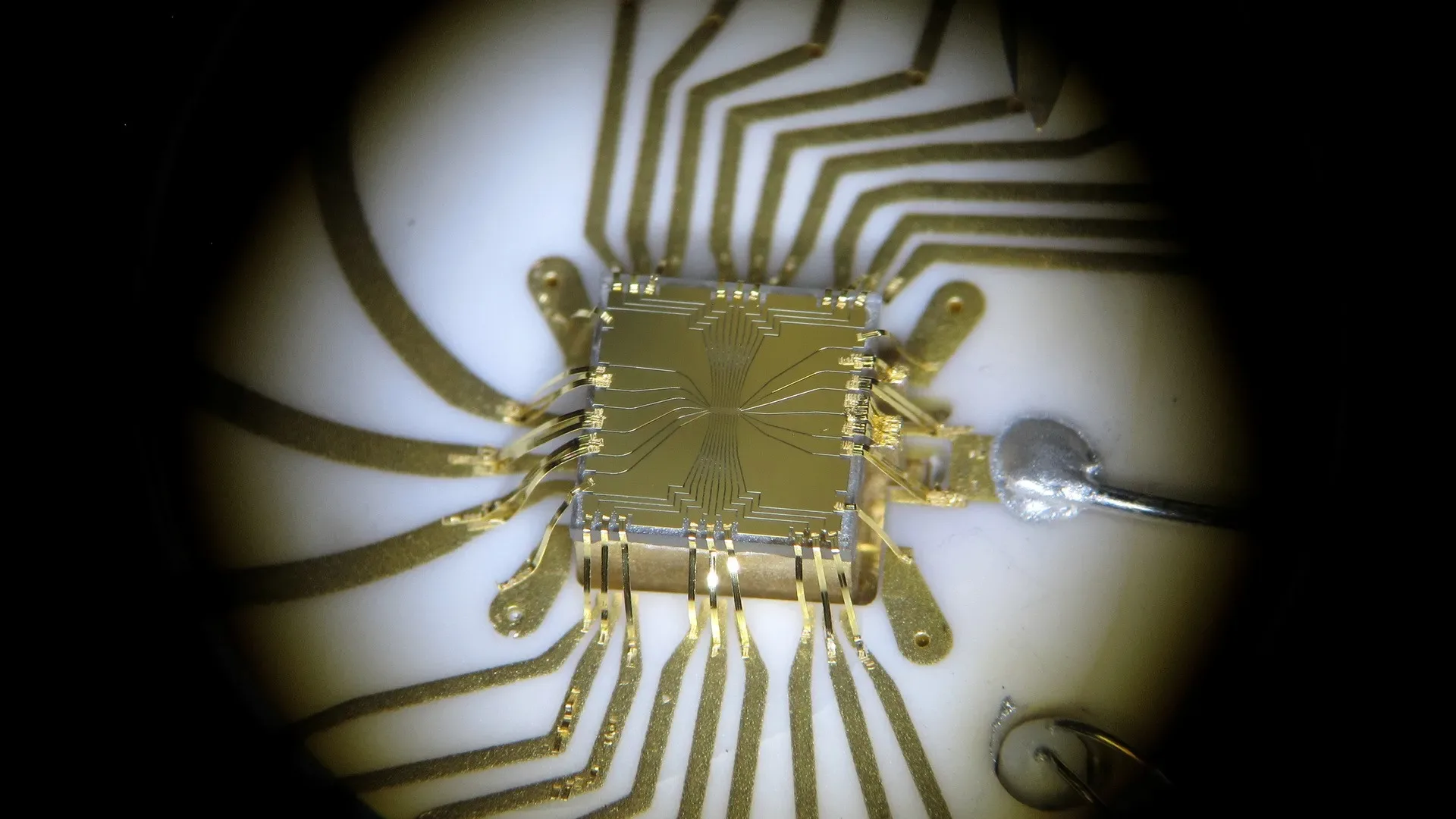
Gold electrodes on a sapphire chip in a NIST ion trap. Photo by D. Slichter/NIST.
Different quantum devices give their two reference states different physical meanings. They can correspond to two energy states of a trapped ion or two paths for light. The fiber-optic internet explainer explains another use of light as a carrier. In a single-photon experiment the readout records individual detection events.
Why superposition matters in quantum computing
Quantum gates let an algorithm change how amplitudes combine. In the H example, the final gate brings information about phase into a measurement you can read. Larger algorithms use sequences of gates to redistribute the probabilities of results. For a task to gain an advantage, the algorithm has to make the result you care about more likely or otherwise extract useful information from the distribution.
With several qubits, their state can include amplitudes for many bit strings. A standard measurement still returns one bit string per run. The size of the state description alone says little about how much you can learn from it. The useful questions are which operations the algorithm applies, what pattern of results it predicts, and how many runs are needed to estimate that pattern.
Is superposition the same as entanglement?
One qubit on its own can exhibit superposition. Entanglement concerns a joint state of several systems that cannot be factored into separate states for each. Two qubits can each be in the plus state independently. Measuring them directly produces 00, 01, 10, and 11 with equal probabilities. A particular entangled state of two qubits gives only 00 and 11 in the same ideal readout. To establish entanglement, those correlations are tested in more than one basis, since shared classical randomness can also produce matching bits.
Do all quantum technologies rely on a qubit superposition?
Different devices use different properties of quantum mechanics. Quantum dots in displays use size-dependent energy levels to tune the color of emitted light. The guide to how quantum dots turn size into color follows that process. For a claim about a qubit superposition, look for a change in measured outcomes when a test changes phase or the measurement basis.
Sources
1. IBM Quantum Learning — Quantum information and single-system measurements
2. Bach et al. — Controlled double-slit electron diffraction
3. Jacques et al. — Experimental realization of Wheeler’s delayed-choice experiment
4. NIST — Myatt et al. on decoherence of quantum superpositions
Keep reading


Reinforcement Learning Explained With a Worked Example
Reinforcement learning is a way to train an agent to choose actions that maximize expected cumulative reward. The agent interacts with an environment, receives...


What Is Biocomputing? How Biological Computers Work, Examples and Applications
In 2022, researchers connected living human and mouse neurons to a simulated Pong game and reported that the cultures changed their behavior with structured fee...


Gemini 4 Neon vs GPT-6.2 Sol: Speed Evidence and Three Practical Tests
Sol looks promising for turnaround, while Neon merits a trial when reasoning errors cause rework. Compare the published evidence and repeat three practical tests on your own work.