What Is Biocomputing? How Biological Computers Work, Examples and Applications

In this story
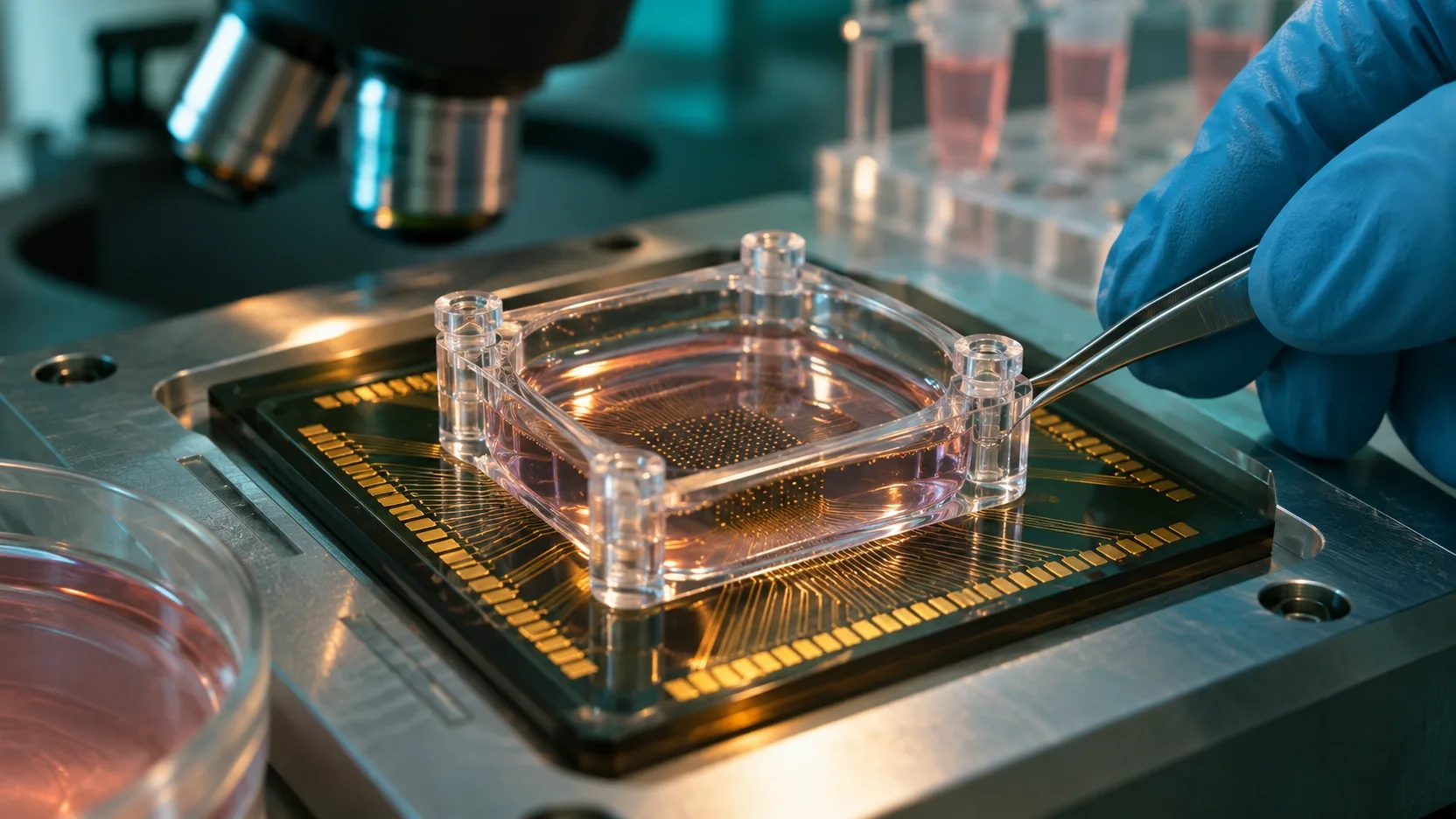
In 2022, researchers connected living human and mouse neurons to a simulated Pong game and reported that the cultures changed their behavior with structured feedback. The experiment, called DishBrain, did not create a thinking computer but it showed why biocomputing is attracting attention.
Biocomputing uses biological materials or biological processes as part of information processing. Depending on the system, the “processor” may be DNA, engineered cells, living neurons, or a brain organoid connected to electronics. This guide explains how these systems work, what researchers have actually demonstrated, where the technology may be useful, and where the hype runs ahead of the evidence.
What Is Biocomputing?
Biocomputing, or biological computing, can mean different things in academic literature. In this guide, it refers to systems that use biological molecules, cells, tissues, or biological processes to perform part of a computing task.
A conventional computer processes information with electronic circuits. A biological computer may instead use DNA reactions, gene-regulation networks, or neural activity. The biological material is the substrate—the physical material that performs part of the information processing. A 2026 Nature Chemical Engineering review describes biocomputation across systems involving nucleic acids, proteins, cells, small molecules, and other biological circuitry.
The idea is broader than “brain cells on a chip.” Molecular computing, cellular computing, neural biocomputing, and organoid-based computing can all fit under the umbrella when biology is doing part of the information processing.
Biocomputing vs Bioinformatics
Bioinformatics usually uses conventional computers to analyze biological data. Biocomputing uses biology itself as part of the computing system.
For example, software comparing DNA sequences is bioinformatics. DNA molecules arranged to perform a logical operation are biocomputing. For a broader look at how computers are used to study biology, see WhatTheTech’s guide to computational biology. What Is Computational Biology?
How Does Biocomputing Work?
Most biological computers follow the same high-level pattern:
Input → Biological processing → Signal measurement → Output
An input may be a molecule, light signal, electrical pulse, or digital pattern. The biological system then changes in a measurable way. Software and electronics interpret that response and turn it into a usable output.
Biological Information Processing
Different systems process information differently. DNA strands can bind or separate according to engineered rules. Cells can change gene activity in response to signals. This is gene regulation: the control of when and how strongly a gene is used.
Neural systems work through electrical and chemical activity. Neural plasticity—the ability of neural networks to change their connections or responses over time—is one reason researchers are interested in living neurons for adaptive computing.
How Biological Systems Connect to Computers
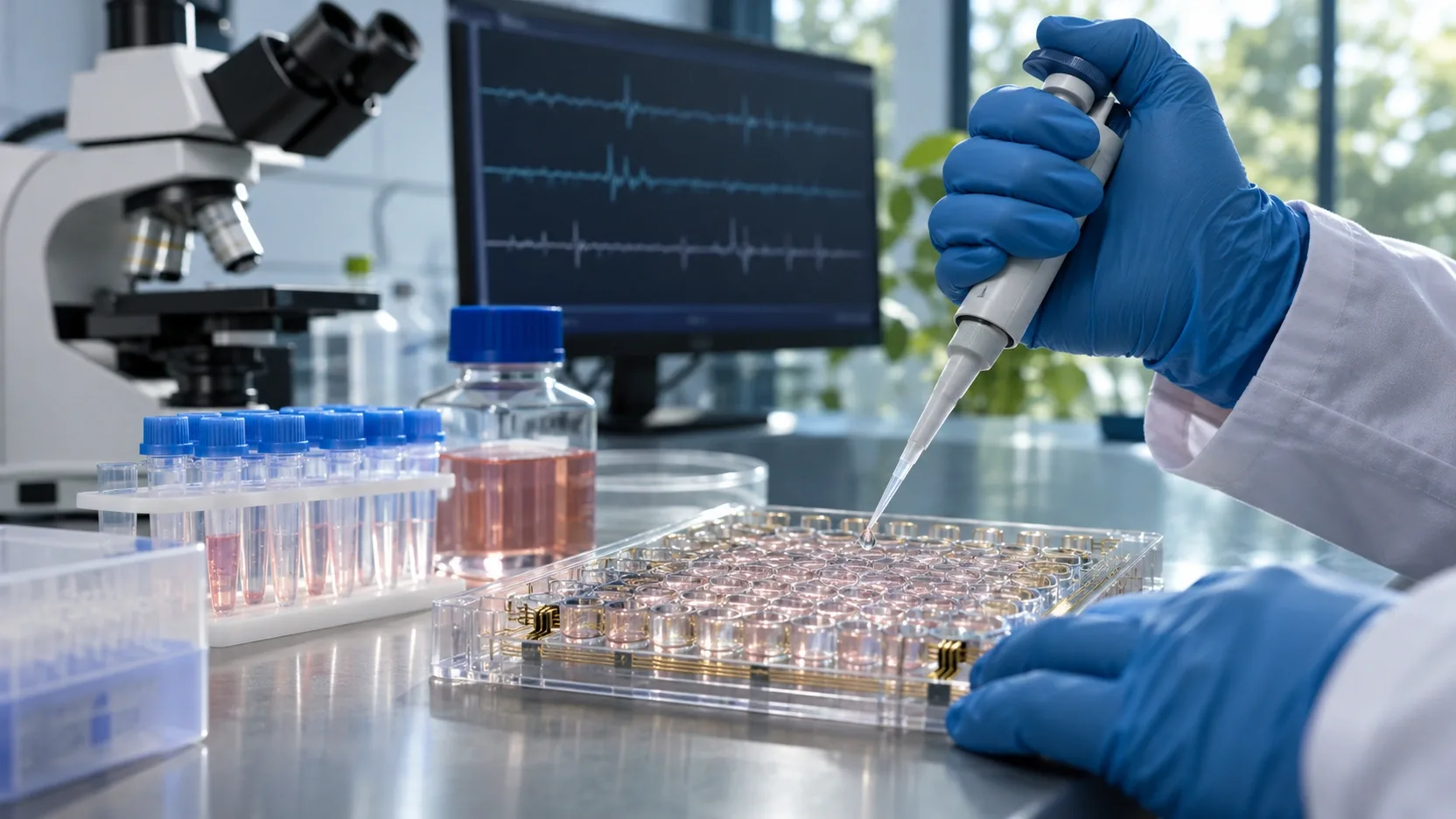
Neural experiments often use a multielectrode array, a chip covered with tiny electrodes that can record neural activity and deliver electrical stimulation.
When recorded activity affects what happens next, and the new event is fed back to the cells, the system forms a closed loop. This closed-loop feedback is central to experiments such as DishBrain.
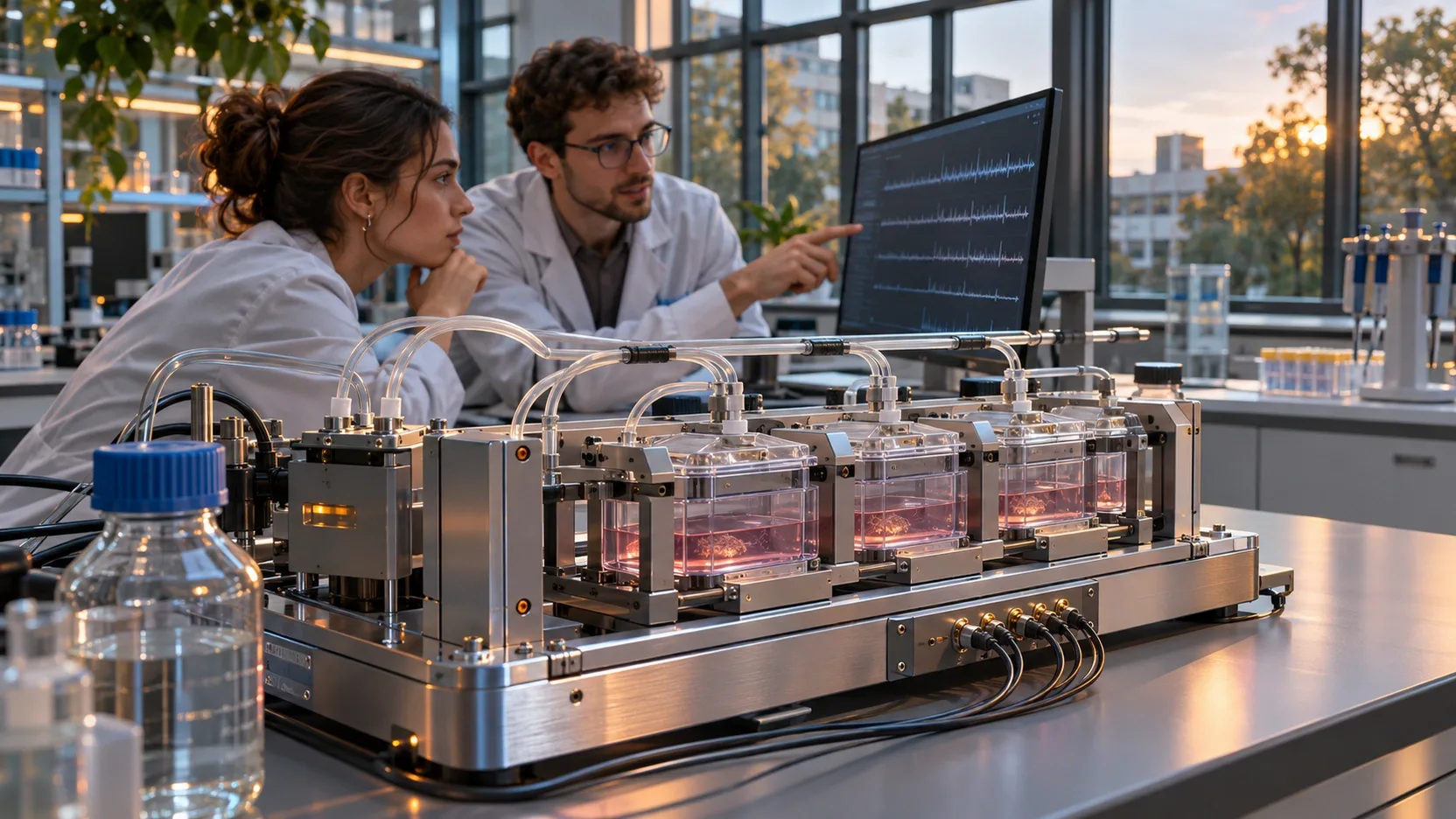
Most current systems are biohybrid computers: biology performs part of the processing, while conventional electronics handle control, measurement, storage, and software.
Types of Biocomputing
DNA Computing
DNA computing uses DNA molecules and biochemical reactions to perform calculations or logical operations.
The field has a famous starting point. In 1994, USC computer scientist Leonard Adleman used DNA to solve a small instance of the directed Hamiltonian path problem, demonstrating that molecular-biology tools could perform a computation.
DNA computing is not the same as DNA data storage. DNA storage encodes digital files in DNA sequences for later retrieval. DNA computing uses molecular reactions to transform or evaluate information. Dense storage does not automatically mean fast computation.
Modern DNA circuits can implement switches, logic gates, amplifiers, and biosensing functions.
Cellular Computing
Cellular computing uses living cells as information-processing systems. Synthetic biology—the engineering of biological systems for useful functions—can program cells to detect inputs and trigger responses through genetic or signaling circuits.
A cell might effectively implement an “AND” rule: respond only when two molecular conditions are present. This approach is attractive for tasks that require sensing and decision-making inside a biological environment.
Neural Biocomputing
Neural biocomputing uses living neurons connected to electronics. Researchers stimulate the cells, record their activity, and use that activity in a computational task.
Unlike digital logic, living neural networks can change with experience. That adaptability is interesting, but it also creates problems with repeatability, lifetime, and control.
Organoid Intelligence
Organoid intelligence overlaps with neural biocomputing but usually involves three-dimensional neural organoids rather than flat cell cultures.
A brain organoid is a lab-grown 3D tissue model that reproduces selected features of developing neural tissue; it is not a miniature complete brain. Organoid systems are being studied for both computing and neuroscience, but ordinary organoid research is not automatically biocomputing.
WhatTheTech’s dedicated organoid intelligence guide covers this area in more detail. Organoid Intelligence Explained
Real-World Biocomputing Examples
A useful way to judge progress is by technological maturity:
Laboratory principle → Experimental demonstration → Research platform → Specialized deployment → Mainstream adoption
No current biological computer has reached mainstream adoption.
DNA and Cellular Computing Experiments
Adleman’s 1994 DNA experiment sits near the “laboratory principle” end of the scale: it proved that DNA chemistry could perform computation, but it was not a general-purpose molecular computer.
Modern DNA circuits can act as switches, logic gates, amplifiers, and biosensing systems. Engineered cellular circuits extend that idea into living cells. These approaches are especially relevant when the input is already biochemical.
DishBrain: Brain Cells Playing Pong
In 2022, Brett Kagan and colleagues reported DishBrain in Neuron. Human stem-cell-derived neurons and mouse cortical neurons were grown on a high-density multielectrode array and connected to a simplified Pong-like environment.
The cells received electrical information about the game, while their activity influenced the paddle. The researchers reported apparent learning within five minutes under structured closed-loop feedback, an effect not seen in the same way under control conditions.
The experiment showed adaptive behavior in an in-vitro neural network—neurons maintained outside an organism. It did not show human-like understanding, general intelligence, or consciousness.
Brainoware: Brain Organoid Computing
In 2023, researchers reported Brainoware in Nature Electronics. They connected a 3D brain organoid to a high-density multielectrode array and used its responses as part of a reservoir-computing system.
Reservoir computing is a machine-learning approach that sends inputs through a complex dynamic system and trains a simpler readout to interpret the resulting patterns. Brainoware was demonstrated on speech-recognition and nonlinear-equation-prediction tasks.
The result matters because the living organoid contributed useful dynamics to a defined computation. It did not demonstrate a general-purpose AI system.
Cortical Labs CL1
Cortical Labs has turned neural biocomputing into a developer-oriented research platform. Its CL1 grows living neurons on a silicon interface and exposes recording, stimulation, and real-time closed-loop control through a Python API.
The company’s simulator lets developers test CL1-compatible code locally, but Cortical’s own documentation states that its simulator uses random or replayed non-learning data. It is a software-development tool, not a simulation of the trainable behavior of living neurons.
As of November 2026, Cortical Labs operates a CL1 purchase page and Cortical Cloud access. I found no verified public CL1 price on the accessible purchase-page data, so no price figure is quoted here.
FinalSpark Neuroplatform
FinalSpark takes a remote-access approach. Its Neuroplatform currently provides 24/7 remote access to brain organoids, real-time neural stimulation and recording, a Python API, data storage, and shared or dedicated organoid configurations.
The service is aimed at researchers and institutions. The dedicated configuration is currently listed as contact for pricing. FinalSpark also provides recorded neural-activity datasets.
Artificial Intelligence and Adaptive Computing
Living neural networks can adapt, which makes them interesting for experimental learning systems. DishBrain and Brainoware show that biological networks can contribute to narrowly defined computational tasks.
That is not evidence that biological computers can replace GPUs or modern AI systems. Their near-term value lies in studying adaptive computation and testing new biohybrid architectures.
For comparison with systems that learn through physical interaction without living neurons, see WhatTheTech’s guide to embodied AI. Embodied AI Explained With Examples
Biosensors and Biomedical Research
DNA and cellular systems can potentially sense biological molecules and process information in the same environment. This could support biosensing, diagnostic research, or systems that respond to combinations of molecular signals.
A biosensor detects a biological or chemical target and converts it into a measurable signal; biocomputing adds information-processing logic to that workflow. WhatTheTech’s biosensor guide explains the sensing side in more detail. Biosensors and How They Work
Synthetic Biology and Programmable Cells
Synthetic biology can engineer cells to perform conditional logic, coordinate responses, or control gene activity.
These systems are still mainly research technologies, but they show why biocomputing does not need to outperform a desktop CPU to be useful. Its advantage may be operating where conventional electronics cannot directly sense or act.
Advantages and Disadvantages of Biocomputing
Potential Advantages
Biocomputing may offer massive molecular parallelism, direct interaction with biological signals, and adaptive behavior in neural systems. DNA circuits can work directly with molecular inputs, while living neural networks can change their responses through plasticity.
Energy efficiency is also a research motivation, but meaningful comparisons must include the whole system: incubators, nutrient delivery, pumps or fluidics, stimulation electronics, recording hardware, supporting computers, and monitoring.
Technical Limitations, Ethics and Reality vs. Hype
Biological systems are variable. Two cultures may not behave identically, and performance can change with age, environment, or maintenance conditions. Reliability, lifespan, standardized benchmarks, manufacturing, and scalability remain major barriers. Recent neural-organoid reviews continue to identify measurement and standardization as important challenges.
Neural systems also raise ethical questions about donor consent, tissue use, research oversight, and safeguards for increasingly complex future models. Current evidence does not show that today’s neural organoids are conscious.
Claim | What the evidence supports |
Living neurons can process information | Supported in controlled experiments |
Neural cultures can adapt to feedback | Supported for specific tasks |
DNA can perform logical operations | Well established experimentally |
Specialized biological computers are accessible | Yes, for research and development |
Biological computers always use less energy | Not established at whole-system level |
Biological computers are faster than GPUs | Not established |
Biological computers can replace current AI | Not demonstrated |
Biological computers are conscious | No evidence |
Biocomputing vs Traditional and Quantum Computing
Feature | Biocomputing | Traditional computing | Quantum computing |
Substrate | Molecules, cells, neural tissue | Semiconductor transistors | Qubits |
Processing | Biological reactions or neural dynamics | Digital logic | Quantum operations and interference |
Typical strengths | Biological sensing, adaptation, molecular logic | Reliable general-purpose computing | Specialized quantum algorithms |
Speed | Highly task-dependent | Extremely fast and mature | Task- and hardware-dependent |
Adaptability | Intrinsic in some neural systems | Usually software-driven | Not biological learning |
Reliability | Major research challenge | Very high | Hardware errors remain challenging |
Scalability | Early | Industrial scale | Early |
Energy comparison | Needs whole-system benchmarks | Mature metrics | Hardware-dependent |
Commercial maturity | Research/early commercial | Mainstream | Research/early commercial |
Consumer availability | No general-purpose products | Yes | Mainly cloud/research access |
Biocomputing and quantum computing are not alternative versions of the same machine. A quantum computer uses quantum physics for specialized computational methods; a biological computer uses biological processes.
For the quantum side of the comparison, see WhatTheTech’s quantum computing basics guide. Quantum Computing Basics for Beginners
Can You Buy a Biological Computer?
Biocomputing Companies, Pricing and Access
Two prominent neural-biocomputing companies are Cortical Labs and FinalSpark, but their access models differ.
Feature | Cortical Labs CL1 | FinalSpark Neuroplatform |
Biological component | Living neural network | Brain organoids |
Platform | Physical CL1 plus cloud access | Remote research platform |
Access | Purchase / Cortical Cloud | Shared or dedicated remote access |
Programming | Python CL API | Python API |
Research capability | Recording, stimulation, closed-loop experiments | Remote stimulation and recording |
Target users | Developers, researchers, labs | Researchers, universities, labs |
Public pricing checked Nov. 2026 | No verified public CL1 price found | Dedicated: contact for pricing |
Local biology lab needed | CL1 includes life-support functions | No for remote users |
Main limitation | Experimental biological variability | Remote research platform |
These are specialized research systems, not consumer computers. Company claims about efficiency or superiority should be separated from independently reproduced scientific benchmarks.
The Future of Biocomputing
The most realistic future for biocomputing is specialized rather than universal. DNA and cellular systems may become useful where sensing and computation need to happen directly in biological environments. Neural platforms may improve as researchers develop better interfaces, benchmarks, culture stability, and software tools.
The biggest hurdle is moving from an impressive demonstration to a reproducible technology. A system must work across samples, laboratories, and time—not only once under carefully controlled conditions.
Biocomputing does not need to replace silicon to matter. If biology proves better for a narrow class of sensing, research, or adaptive-computing problems, biohybrid systems could become valuable alongside conventional and quantum hardware.
Frequently Asked Questions
Are Biological Computers Faster Than Normal Computers?
Not in general. DNA, cells, and neurons operate on different timescales, and many biological processes are slower than electronic switching. Some systems gain parallelism or adaptability, but there is no evidence that biological computers are universally faster than conventional computers or GPUs.
Do Biological Computers Use Less Energy?
Possibly for some specific tasks, but whole-system comparisons are not yet strong enough to support a universal claim. Fair benchmarks must include biological maintenance, environmental control, electronics, recording hardware, and supporting computers.
Can Biological Computers Learn?
Some living neural systems show plasticity and task adaptation under controlled feedback. Researchers often describe this as learning-like behavior. That is not the same as human understanding or general intelligence.
Can Biological Computers Become Conscious?
Current experiments have not demonstrated consciousness or sentience. Neural activity, adaptation, and task performance are measurable; consciousness is a separate claim requiring much stronger evidence. Ethical oversight still matters because these systems can involve human-derived neural tissue.
What Is Wetware Computing?
Wetware computing usually refers to computation using living biological material, especially neurons or neural tissue. It overlaps with biocomputing, although biocomputing is broader and can also include DNA and cellular systems.
Is Biocomputing the Same as Neuromorphic Computing?
No. Neuromorphic computing uses electronic hardware designed to imitate aspects of biological neural systems. Neural biocomputing uses actual living neurons or neural tissue as part of the processor.
Sources:
Keep reading
Reinforcement Learning Explained With a Worked Example
Reinforcement learning is a way to train an agent to choose actions that maximize expected cumulative reward. The agent interacts with an environment, receives...


Gemini 4 Neon vs GPT-6.2 Sol: Speed Evidence and Three Practical Tests
Sol looks promising for turnaround, while Neon merits a trial when reasoning errors cause rework. Compare the published evidence and repeat three practical tests on your own work.
What Is a Quantum Network and How Does It Work?
A quantum network connects devices that send quantum states or share entanglement. It uses photons to carry quantum information over links such as optical fiber...