What Is a Quantum Network and How Does It Work?

In this story
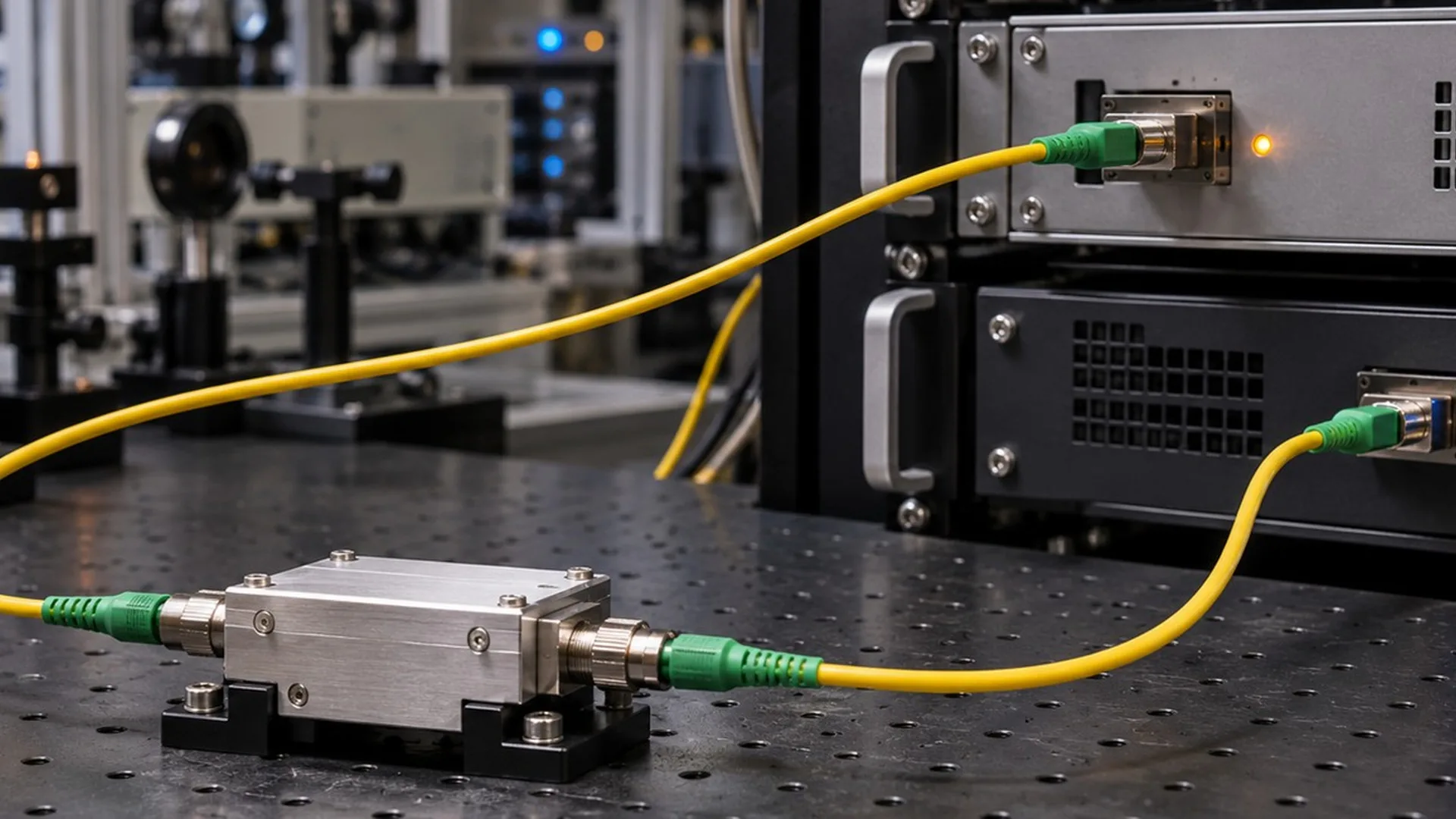
A quantum network connects devices that send quantum states or share entanglement. It uses photons to carry quantum information over links such as optical fiber, and it uses ordinary data connections to coordinate operations. Researchers have demonstrated parts of this system over deployed telecom fiber. A general-purpose quantum internet, where many independent devices can request and use shared entanglement across networks, remains a research goal.
The distinction matters when you read about a new milestone. Sending entangled photons through a city, teleporting a quantum state between devices, and linking two processors so they can run part of the same computation are different achievements. The distance alone tells you surprisingly little about which one happened.
How a quantum network works
Nodes hold qubits and photons carry them
A qubit is a unit of quantum information. A device can encode one in a photon’s polarization or in a superposition of two possible arrival times. A quantum memory can hold a qubit in another physical system, such as a defect in a diamond. Photons travel between locations, while memories give the network time to coordinate operations. Some setups use a source and detectors without long-lived memories. For the underlying concepts, see quantum computing basics and how quantum superposition works.
Think of two labs that want to share an entangled pair. One possible design puts a photon source between them. It sends one photon down each fiber. In other designs, photons travel from the endpoints to a midpoint, where a successful measurement can signal that the remote memories are entangled. That signal is called a herald. It tells the endpoints which attempt succeeded so they can use the pair or keep trying.
Related Contents:
Classical messages tell the nodes what to do
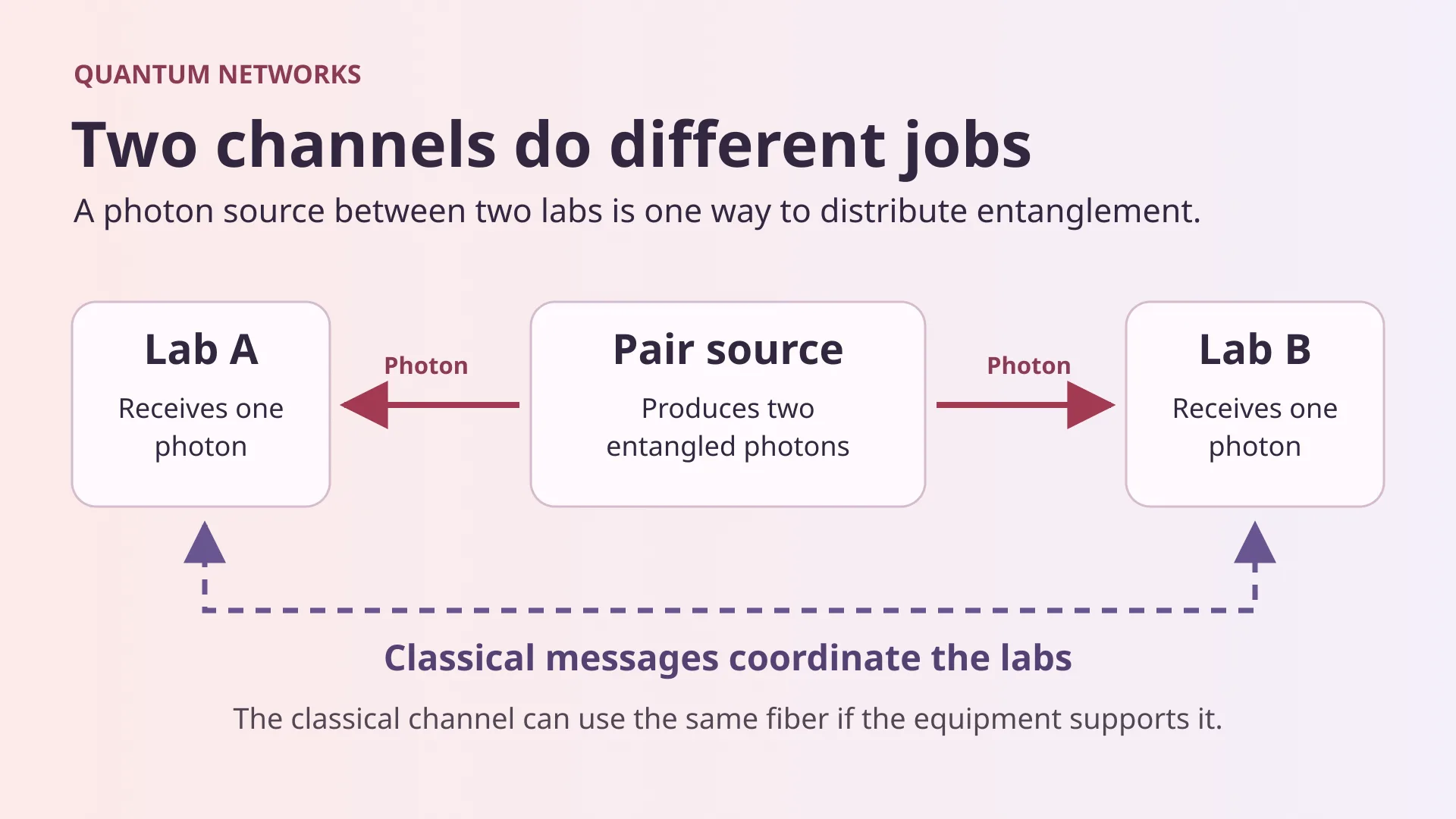
In a source-in-the-middle design, the two labs use a classical channel alongside the optical links.
Entanglement gives the endpoints access to joint quantum correlations. Each endpoint’s local measurement result is random on its own. If one lab wants to use the pair to teleport a qubit, it measures its half of the pair jointly with the input qubit, then sends the measurement result over a classical channel. The receiving lab uses that result to apply the appropriate correction. The original state is consumed in the process, and the classical message limits how soon the receiver can use the teleported state. Quantum internet architectural principles
The two channels can sometimes share a physical cable. In July 2026, Northwestern University reported that its team distributed entangled photons through 24.4 kilometers of deployed fiber between Evanston and downtown Chicago while the fiber carried high-capacity internet traffic. The team reported entanglement fidelity above 94% in that setup. That result describes how closely the measured quantum state matched the intended entangled state. It gives no delivery rate by itself and says nothing about whether remote computers ran a shared computation. Northwestern University field experiment
Why distance is so difficult
Ordinary optical networks can amplify light as it weakens. An unknown quantum state cannot be copied perfectly, so copying a faint qubit signal at intervals is unavailable as a way to restore it. A photon can disappear into the fiber, and even a detected photon may have picked up noise that reduces fidelity. On a shared cable, light scattered from a stronger data channel can add background counts at the quantum receiver. Filtering, wavelength choice, and launch power determine whether a particular fiber route can carry both services. Northwestern University Our guide to fiber optic internet explains how conventional links carry data through the same kind of cable.
A worked example of photon loss
Assume a direct fiber path loses 0.2 decibels per kilometer, an illustrative value rather than a measurement of any named testbed. Over 25 kilometers, the loss is 5 decibels. Transmission is 10 raised to the power of minus the loss divided by 10, so about 32% of photons launched into the fiber survive. At 50 kilometers, the loss reaches 10 decibels and about 10% survive. At 100 kilometers, it reaches 20 decibels and only about 1% survive.
Suppose a source launches one million photons per second into that 100-kilometer path. The fiber-only calculation leaves about 10,000 photons per second at the far end. If the detector registers 80% of arrivals, about 8,000 would register before accounting for any other losses. Connectors, filters, coupling, and protocol requirements can lower the usable rate further. A detector count includes single arrivals and can include noise. An application that needs matched detections or a confirmed pair stored at two nodes must report its own success rate.
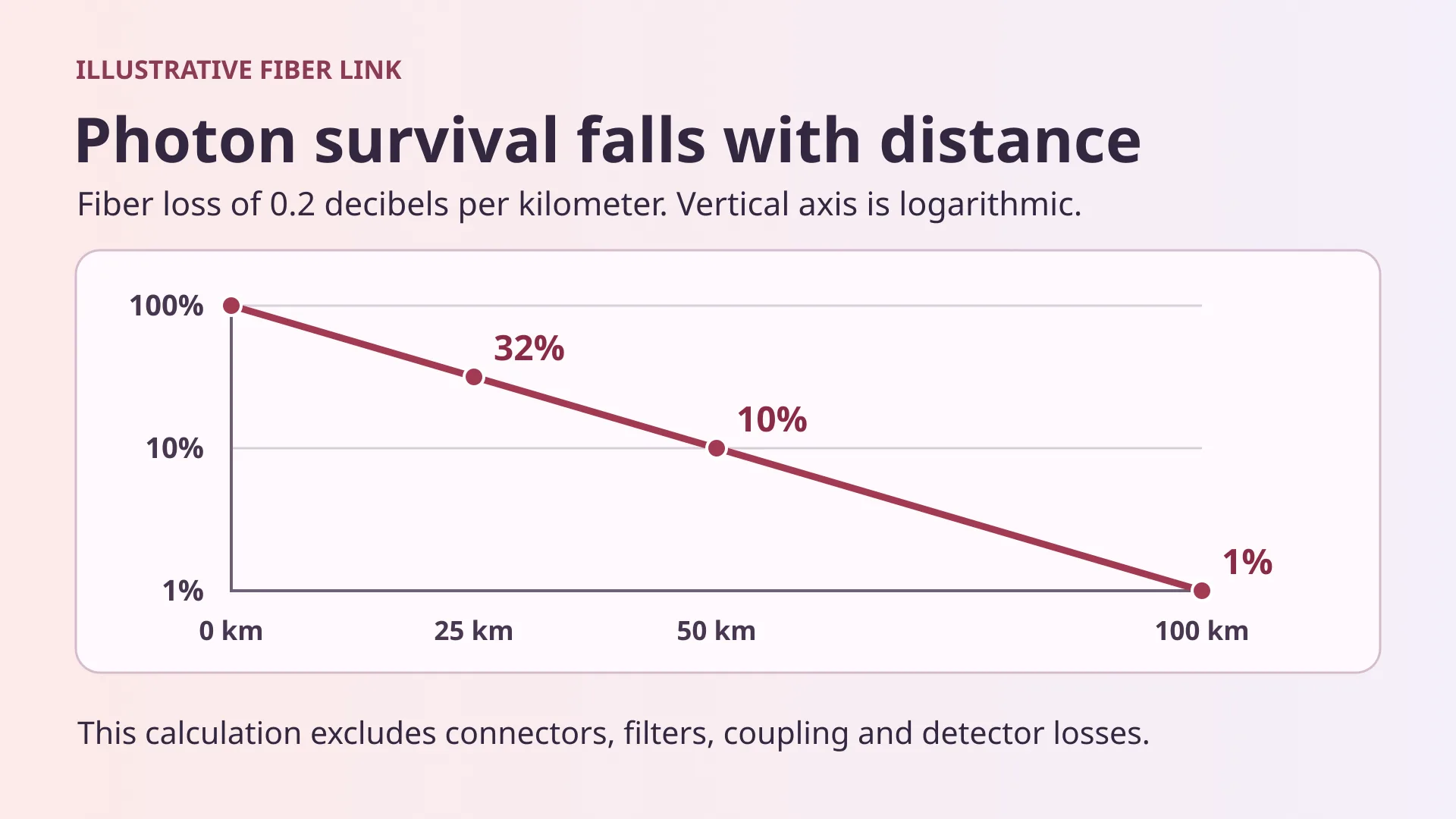
This model includes fiber attenuation only. The vertical axis uses a logarithmic scale.
What quantum repeaters are designed to do
A repeater can create entanglement separately on shorter links and use entanglement swapping to connect them. In a memory-based design, a middle node holds its share of a successful pair while the other link keeps trying. When both are ready, a joint measurement at the middle node can entangle the two outer nodes. Memory lifetime, loss, and measurement errors determine how often this works and how good the resulting pairs are. Other repeater designs use different strategies to handle loss and errors. RFC 9340 on repeaters and entanglement swapping
A three-node experiment illustrates the idea. In 2022, QuTech researchers used an intermediate node to enable teleportation between two diamond-based nodes without a direct link. In a separate experiment reported in 2024, QuTech and collaborators linked independently operating nodes over 25 kilometers of deployed optical fiber. The first study addressed a network operation across multiple nodes. The second addressed the challenges of connecting independent hardware over a metropolitan route. Nature teleportation study · QuTech metropolitan link
What quantum networks could be used for
Use | What the link supplies | What to look for |
Quantum key distribution (QKD) | Quantum signals help two endpoints establish a shared secret key. An authenticated classical channel is also required. | The final secret-key rate, how endpoints authenticate, and whether any intermediary must be trusted. |
Distributed quantum computing | Entanglement between processors can support operations across machines or modules. | A demonstrated operation between processors, its error rate, and the number of usable pairs delivered per second. |
Networked quantum sensing | Shared quantum states may help sensors make a joint measurement in some designs. | A measured sensitivity gain against a classical baseline that accounts for link loss and other resources. |
Quantum networks for computing face a hardware problem at each end. A processor might store information in a stationary qubit that cannot travel down optical fiber. An interface must couple that qubit to a photon, or otherwise transfer its state across the link, with sufficiently low loss and noise. A fast source of photons is valuable only if the receiving device can use them. NSF overview of quantum networking
In a 2025 experiment, University of Oxford researchers used an optical link between two trapped-ion modules to perform a shared two-qubit gate with about 86% fidelity. The gate was a computation across the two modules. That fidelity measures a different operation from the entangled-photon fidelity reported in the Chicago fiber experiment. Oxford team’s published study
Quantum key distribution and post-quantum cryptography
QKD uses physical signals and measurements to help establish shared keys. The applications using those keys still depend on authenticated devices, key handling, and the security of their endpoints. Some longer QKD routes rely on trusted relay sites. If you are evaluating such a service, check where key material becomes accessible and who operates those sites. NSA post-quantum cybersecurity resources
Post-quantum cryptography (PQC) uses algorithms that run on conventional computers and communicate over conventional networks. NIST’s first three standards cover a mechanism for establishing a shared secret and two approaches to digital signatures. If your organization’s goal is to protect existing web services or document signatures against future quantum attacks, the relevant starting point is identifying which public-key algorithms your systems use and checking your vendors’ support for the applicable standards. NIST post-quantum cryptography standards
How to evaluate a quantum network announcement
Check what moved. A demonstration may deliver photons to a receiver, share a verified entangled state, teleport a qubit, generate secret key bits, or perform an operation across processors. Each output has a different unit. If a press release reports photons per second, look for a separate figure for whichever output the application actually uses.
Check where it happened. A 25-kilometer spool and a 25-kilometer street route can have similar nominal lengths. The deployed route has equipment at separate sites and can introduce environmental drift, patch panels, and constraints on when engineers can access the fiber. Also check whether “25 kilometers” describes the optical path, the distance between endpoints, or a loop running out and back.
Read fidelity alongside rate. An experiment reporting 95% fidelity on one successful pair each second and one reporting 90% on 1,000 pairs each second could suit different applications. The first may meet a minimum fidelity requirement the second misses. The second may meet a minimum throughput requirement the first misses. These are illustrative figures. In real comparisons, verify which state the fidelity refers to and whether failed attempts were excluded from the reported metric.
Find the operational assumptions. Ask whether the fiber carried live data, how long measurements ran, and whether engineers needed to bring the equipment back into alignment during the trial. For key distribution, check the trust model. For a processor link, check whether entanglement ended at optical detectors or was available in memories at both endpoints. These details help you tell whether the experiment addresses the conditions your application will face.
Frequently asked questions
Can I try quantum networking without lab equipment?
Yes. QuTech’s Quantum Network Explorer offers a simulated environment where you can explore quantum network applications. Start with a simple experiment and follow the classical messages as well as the qubits. A simulator helps you understand the protocol. Measuring how a device behaves on a particular fiber route requires physical hardware.
Can a quantum network use satellites?
Yes. Free-space optical links can connect a satellite and ground stations using photons. Where a fiber path would absorb most photons, a satellite route changes the loss problem. The ground station still needs to collect a tiny fraction of a spreading beam and maintain accurate pointing. Weather and the satellite’s visibility also affect when the link can operate. NASA’s quantum communications overview
Does quantum networking make regular downloads faster?
Your phone or laptop still receives conventional data from a server. A quantum link could help specialized devices share quantum states or help endpoints establish keys, while the ordinary network continues to carry the file or stream. Explore related concepts in WhatTheTech’s Quantum Tech guides.
Keep reading
Reinforcement Learning Explained With a Worked Example
Reinforcement learning is a way to train an agent to choose actions that maximize expected cumulative reward. The agent interacts with an environment, receives...
What Is Biocomputing? How Biological Computers Work, Examples and Applications
In 2022, researchers connected living human and mouse neurons to a simulated Pong game and reported that the cultures changed their behavior with structured fee...


Gemini 4 Neon vs GPT-6.2 Sol: Speed Evidence and Three Practical Tests
Sol looks promising for turnaround, while Neon merits a trial when reasoning errors cause rework. Compare the published evidence and repeat three practical tests on your own work.