How Quantum Dots Turn Size Into Color

In this story
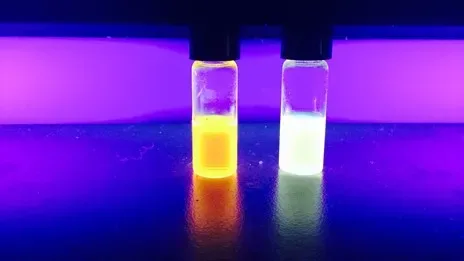
Quantum dots are tiny regions of semiconductor that confine electrons in all three dimensions. In a TV, they typically take the form of nanocrystals just a few nanometers wide. Their size helps set the color they emit when light excites them. That lets a display turn some of its blue light into distinct red and green light, giving the screen more control over the colors it produces.
The same idea of confining electrons also turns up in research on quantum computers. There, engineers can use electrodes to trap individual electrons in a chip and use their spin to store quantum information. The TV and the chip use confinement to do different jobs.
What are quantum dots?
A nanometer is one billionth of a meter. At the scale of a quantum dot, the boundaries of a semiconductor can affect which energies an electron can have. Researchers call this quantum confinement. The 2023 Nobel Prize in Chemistry went to Aleksey Yekimov, Louis Brus, and Moungi Bawendi for work on the discovery and synthesis of quantum dots. The Nobel Prize backgrounder traces the work from size-dependent effects in glass to methods for producing more uniform particles.
Uniformity matters because a batch of dots contains a population of crystals. When their sizes vary, they can emit at slightly different wavelengths. A narrower size distribution helps keep the batch’s emission within a narrower band of colors.
Read More:
How quantum confinement changes color
When a dot absorbs a photon with enough energy, an electron can move into a higher-energy state. It leaves behind a hole, which behaves like a positive charge in the semiconductor. When the electron and hole recombine, the dot can release some of that energy as a new photon. This light-driven emission is called photoluminescence.
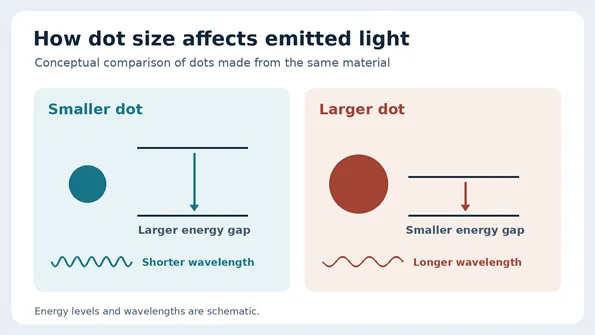
For dots with the same composition and comparable structure, a smaller dot confines the charges more tightly and generally has a larger effective energy gap. Its emitted photon carries more energy and has a shorter wavelength. A larger dot generally emits at a longer wavelength. A size comparison works best when the rest of the material design stays similar. Nobel scientific background on the size effect.
What composition and surface chemistry change
The same diameter can produce different colors in different semiconductors. The core material sets the starting electronic properties. Many dots also have an outer shell made of another semiconductor. A suitable shell can reduce the chance that defects at the surface drain energy that could have produced light. Molecules attached to the outside can help the particles stay dispersed in a liquid or compatible with the layer where they will be used. Nature Nanotechnology’s account of display materials.
Wavelength is a property of the light coming out of the dot. The dot itself is only a few nanometers across, while its visible emission can have a wavelength of hundreds of nanometers. Wavelength is also how engineers describe the light carrying data in fiber-optic internet. The fiber guides that light along a path.
For scale, a blue photon at 450 nanometers carries about 2.76 electron volts of energy. A red photon at 630 nanometers carries about 1.97 electron volts. That leaves roughly 0.79 electron volts between those illustrative input and output photons. In this kind of conversion, some energy can go into vibrations in the material. The photon energies also explain why a red-emitting dot can be excited by blue light in the first place.
How quantum dots work in QLED and QD-OLED
On a US retail listing, QLED typically refers to an LCD television with a quantum dot layer. QD-OLED uses an OLED light source with quantum dot color conversion. Both can use blue light to excite dots that emit red and green. The biggest architectural difference is where the blue light comes from and how the screen controls it.
Display design | Where the light starts | What the quantum dots do |
QLED LCD | A blue LED backlight illuminates the LCD panel. | A quantum dot layer converts some blue light to red and green. The LCD regulates how much light passes through each pixel. |
QD-OLED | Blue OLED emitters provide light that can be controlled at the pixel level. | Quantum dots convert blue light in red and green subpixels. Blue light supplies the blue subpixels. |
Electroluminescent quantum dot display | Electrical charges enter the quantum dot emitting layer. | The dots emit light directly when injected electrons and holes recombine. |
Why a narrow band of color matters
A dot tuned to emit red can concentrate its output into a relatively narrow range of wavelengths. Pair red and green emission with blue light, and the panel designer can produce more distinct primary colors. That can expand the color gamut, the range of colors the screen can reproduce. Color volume adds brightness to the picture by asking how much of that range remains available at different luminance levels. Samsung Display’s description of QD-OLED color conversion.
What Mini LED changes
Mini LED describes the LCD backlight. Smaller LEDs can help manufacturers divide the backlight into more dimming zones. Quantum dots still handle color conversion, so a model can be both Mini LED and QLED. A small bright object on a dark background may share an LCD dimming zone with nearby dark pixels, which can produce a visible halo. QD-OLED controls light at the pixel level, so it handles that scene differently. Samsung’s QLED architecture guide.
The term QLED also appears in some scientific papers as shorthand for an electrically driven quantum dot light-emitting diode. Read how the paper powers the device before comparing it with a TV. A 2019 study demonstrated electrically driven devices using indium phosphide quantum dots. The original device study in Nature.
How to check a quantum dot display claim
Suppose a product page promises “richer colors,” and you want to know whether that will help with HDR movies in a room that gets afternoon sun. Work from the screen’s design to the measurements that matter in that room.

Start with the exact model and its measured color
Check the panel type for the exact model and screen size you are considering. Then look for independently measured HDR color volume if you want to know how well bright, saturated colors hold up. A gamut percentage can describe which colors are reachable under the test conditions, while color-volume testing can tell you how that range changes with brightness. Compare results made under the same test method and picture settings. RTINGS’ measured comparison of QD-OLED and QLED TVs.
Check the room with one bright scene and one dark scene
If you can see the TV in person, replay a daylight scene with saturated highlights and a dark scene with subtitles. Use the same source and comparable picture modes. Look for whether the colors in the bright scene keep their saturation, whether light from the room is visible on the screen, and whether subtitles create halos in dark areas. Try the dark scene with the lights down and again with the room lit.
The exercise gives you three observations to match against a review. Color volume helps explain bright color, reflection or ambient black tests explain some room-light effects, and contrast or local dimming tests help explain halos. A display’s quantum dot layer tells you where some of its light comes from. These observations tell you what the finished panel does with that light.
Where quantum dots are used beyond TVs
Fluorescent labels and sensors
In imaging research, quantum dots can act as labels that emit light in chosen wavelength bands. Multiple labels can be useful when researchers want to distinguish several targets in the same sample. In a 1998 proof of concept, Warren Chan and Shuming Nie used quantum dots as fluorescent labels in a biological detection experiment. A lab demonstration establishes what the marker can do under those conditions. Use in people calls for separate evidence on how the particles behave in the body. The original Science study shows the experiment. Our guide to biosensors explains how instruments turn a measurable signal into a result.
Solar cells and light detectors
Some solar-cell and photodetector designs use quantum dots to absorb light in a chosen part of the spectrum. The device then needs to collect charge and deliver it to an electrical circuit. Surface chemistry and how the particles connect in a film influence whether charges can move through the material. When you read about a promising solar cell, look for efficiency measured on the whole device, along with how long it maintained that performance. The National Science Foundation’s survey of quantum dot applications.
Quantum dots in quantum computing
A silicon spin-qubit device can use voltage on tiny electrodes to confine electrons inside a semiconductor chip. A state of the electron’s spin can encode a qubit. In 2022, a research team reported control of six spin qubits in silicon quantum dots. A useful measure in this application is how accurately the hardware can prepare, control, and read the qubit states. The original six-qubit study describes the device, and our quantum computing basics guide explains how qubits and gates fit into a computation.
Do all quantum dots contain cadmium?
Some common research materials use cadmium compounds such as cadmium selenide. Others use materials such as indium phosphide. A claim about a particular screen or lab product requires information about the dots used in that product. Composition, coating, and how a material is incorporated into a device all matter when assessing exposure.
Keep reading


How to Get Your Business on ChatGPT
Claim or add your business in ChatGPT Business Hub, complete verification, and use Insights to see how customers discover your business.

Organoid Intelligence Explained
Organoid intelligence is a field of research that connects lab-grown neural tissue to electronics and software. Researchers use the resulting systems to study h...
Quantum Computing Basics for Beginners
A quantum computer uses qubits to represent information. Its gates change how likely different outcomes are when you measure the qubits. Some algorithms use tho...