




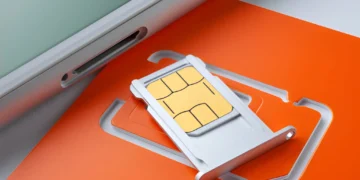






A free SIM card is real, but it does not always mean free phone service. In the US, “free SIM” usually means the physical SIM or eSIM costs $0, activation is discounted, or an eligible customer gets reduced-cost service through a program such as Lifeline. The phone plan may still require monthly payment, taxes, shipping, activation, or an unlocked compatible phone.
Before ordering, check five things: what is free, what the monthly service costs, whether your phone is compatible, whether checkout adds fees, and whether the offer appears on an official provider page.
The Best Ways to Get a Free SIM Card
The best way to get a free SIM card depends on what you actually need.
| Your situation | Best place to start | What may be free | What to check first |
| You qualify for low-income phone support | Lifeline provider | Monthly discount, SIM, or service depending on provider | Eligibility, provider availability, and household rules |
| You already have an unlocked phone | Carrier BYOD offer | Physical SIM or eSIM activation | Monthly plan cost, coverage, activation fee, and compatibility |
| You have a newer iPhone or Android phone | eSIM setup from a carrier or provider | eSIM profile or trial activation | Device eSIM support and renewal pricing |
| You need a phone line for a child | Low-cost prepaid or family/kid plan | Sometimes the SIM card | Parental controls, data limits, and unknown caller settings |
| You do not qualify for free service | Cheap prepaid SIM or eSIM plan | Sometimes the SIM kit | First-month total cost, taxes, and data limits |
A free SIM card is usually just the card or digital SIM profile that connects your phone to a network. Free monthly service is more limited. It may depend on Lifeline eligibility, a carrier promotion, an app-based service, or a low-cost prepaid plan with a $0 starter offer.
The 5-Point Free SIM Check Before You Order
Use this quick check before entering personal information or payment details.
| Question | Why it matters |
| Is the SIM or eSIM actually free? | Some offers only waive the SIM kit cost, not the service cost. |
| Is monthly service included? | A free SIM often still requires a paid phone plan. |
| Is your phone unlocked and compatible? | A locked or incompatible phone may not activate. |
| Are there checkout fees? | Shipping, taxes, activation, or first-month charges can turn a “free” offer into a paid order. |
| Is the page official? | Government-style or “free phone” pages can be misleading if they are not tied to a verified provider. |
If an offer fails any of these checks, pause before ordering.
What Does “Free SIM Card” Actually Mean?
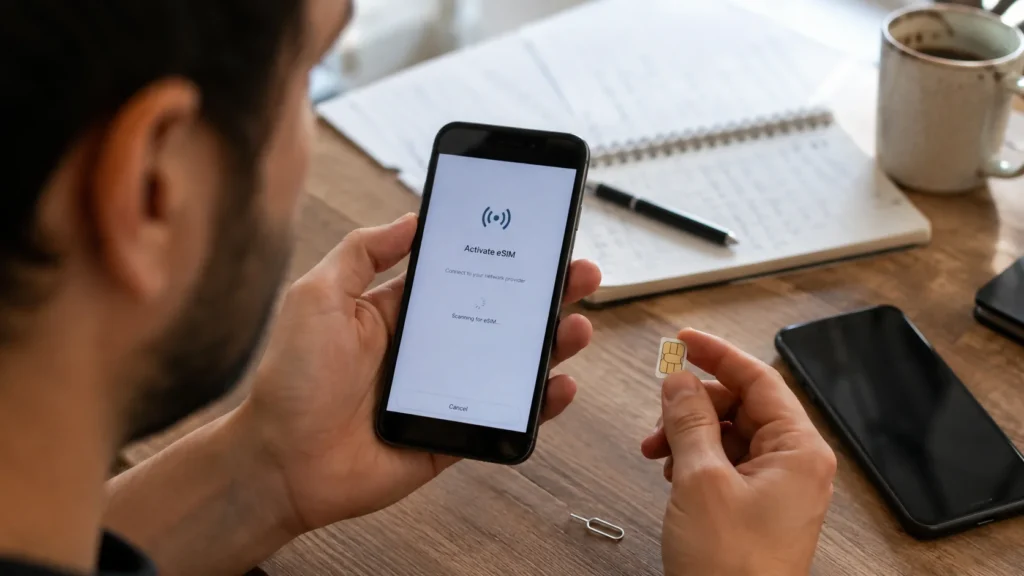
A SIM card connects your phone to a mobile network. An eSIM does the same job digitally, without a removable card. The confusing part is that “free” can mean several different things.
| Offer wording | What it usually means | What it does not always include |
| Free SIM card | The physical SIM kit costs $0 | Free monthly service |
| Free eSIM | The digital SIM profile can be installed without shipping a card | Free data or unlimited service |
| Free activation | The setup fee may be waived | SIM cost, taxes, or monthly plan cost |
| Free service | Monthly service may be discounted, limited, app-based, or promotional | Unlimited high-speed data with no restrictions |
| Free government SIM | Usually refers to a Lifeline provider offer | Guaranteed approval or availability everywhere |
| Free phone + SIM | A provider-specific offer, often tied to eligibility | The same terms from every provider |
The simple rule: the SIM is the access key, but the plan is the service. A provider can give you the SIM for free and still charge for monthly talk, text, data, taxes, or activation.
Related Contents:
Can You Get a Free SIM Card With Free Service?
Yes, but only in specific cases.
Free or near-free service is most realistic when one of these applies:
- You qualify for Lifeline.
- A provider includes a SIM as part of an eligibility-based plan.
- A carrier is running a limited promotion.
- You use an app-based calling and texting service.
- You only need limited service over Wi-Fi or light cellular data.
The most important distinction is this: a free SIM card does not automatically include a free phone plan. Always check the plan page, checkout screen, and terms before ordering.
Can You Get Free Unlimited Talk, Text, and Data?
You may see offers that mention free unlimited talk, text, and data, but the word “unlimited” needs a close look. In mobile plans, unlimited does not always mean unlimited high-speed data with no restrictions.
Check the plan terms for these details:
| Claim | What to verify |
| Unlimited talk and text | Is it cellular service, app-based calling, or Wi-Fi-dependent? |
| Unlimited data | Is there a high-speed data cap before speeds slow down? |
| Free data | Is data limited to certain apps or essential services? |
| 5G data | Does your phone support the provider’s 5G network? |
| Free monthly plan | Are taxes, fees, or eligibility rules still required? |
| No contract | Does the price change after a trial or promotion? |
A legitimate offer should make these details easy to find. If a page promises unlimited free data but does not explain speed limits, hotspot rules, taxes, plan renewal, or eligibility, treat the offer as incomplete rather than assuming it is a full free phone plan.
Free Government SIM Cards and Lifeline: Who Qualifies?
Many people searching for a “free government SIM card” are really looking for Lifeline.
Lifeline is a federal program that helps eligible consumers reduce the monthly cost of phone, internet, or bundled service. According to USAC, Lifeline can provide a standard monthly benefit, plus an enhanced benefit for eligible consumers on qualifying Tribal lands, but each household can receive only one Lifeline discount.
You may qualify for Lifeline in two main ways.
Income-based eligibility
USAC says consumers can qualify for Lifeline if their income is at or below 135% of the 2026 Federal Poverty Guidelines. The limit depends on household size and state.
Program-based eligibility
You may also qualify through participation in certain government assistance programs. Before you apply, check the official Lifeline eligibility page for the current qualifying programs and documentation requirements.
One discount per household
Lifeline is limited to one discount per household. A household generally means people who live together and share income and expenses.
ACP vs Lifeline: what changed?
Do not confuse Lifeline with the Affordable Connectivity Program. The FCC says the Affordable Connectivity Program ended for now, and ACP discounts ended on June 1, 2024.
That matters because older pages may still mention ACP-style discounts. For current US phone-service help, Lifeline is the official federal benefit to check.
How to Apply for a Free SIM Card Through Lifeline
The safest way to start is through the official Lifeline process, not a random ad, text message, or social media form.
Step 1: Check your eligibility
Start with the official Lifeline eligibility process. You may need to confirm your income, program participation, household status, identity, or address.
Step 2: Find Lifeline providers near you
Use the official Lifeline provider lookup to search by ZIP code, city, or state. Provider availability varies, and not every company offers the same phone, SIM, eSIM, or data terms.
Step 3: Compare SIM, eSIM, BYOD, and phone options
Provider offers vary. One provider may support bring-your-own-device service, another may offer a physical SIM, and another may include a phone with eligible service. Do not assume every Lifeline provider offers the same free SIM, free phone, data amount, or coverage.
Before choosing a provider, check:
- Whether you can bring your own phone.
- Whether the provider offers physical SIM, eSIM, or both.
- Whether coverage is available where you live.
- Whether taxes or fees apply.
- Whether you must use the service regularly to keep it active.
- Whether the plan includes enough talk, text, and data for your needs.
Step 4: Keep your account details and watch for renewal notices
Lifeline is not something to ignore after signup. Keep your account information, provider emails, and benefit notices. If you are asked to confirm eligibility later, missing the notice could affect your service.
Best Legitimate Places to Look for a Free SIM Card
The safest way to compare free SIM options is to group them by source type. This keeps the decision neutral and avoids treating every carrier promotion as the same kind of offer.
| Source type | Best for | What may be free | What to verify |
| Lifeline providers | Eligible low-income households | Monthly discount, SIM, or service depending on provider | Eligibility, state availability, and household rules |
| Carrier BYOD promotions | People with unlocked phones | Physical SIM or eSIM activation | Monthly plan cost, activation fee, taxes, and coverage |
| App-based phone services | Light calling/texting or backup line | Calling/texting, sometimes limited data | App requirements, cellular data limits, and number rules |
| Retail SIM kits | People who want fast setup | Usually not free, but often low-cost | SIM kit price, required plan, and return policy |
| eSIM providers | Newer iPhone and Android users | eSIM profile or trial setup | Trial length, renewal price, and device support |
Do not choose based only on the word “free.” Choose based on the total first-month cost, coverage, data limits, and whether your phone can actually activate on that provider.
Free eSIM Card vs Physical SIM Card
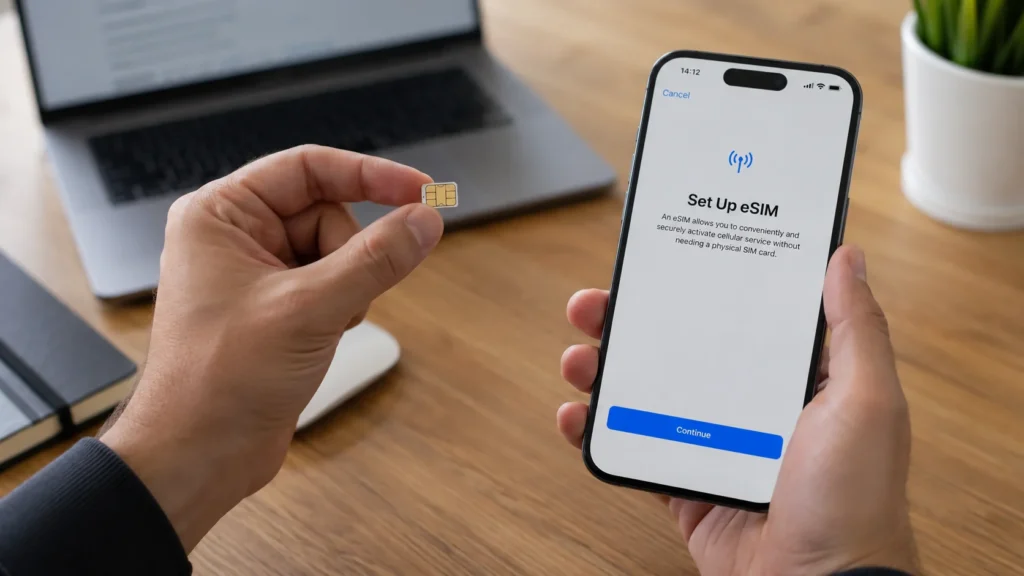
An eSIM is a digital SIM built into supported phones. It can be easier than a physical SIM because there is no shipping delay and no small SIM tray to handle.
When eSIM is easier
Choose eSIM when:
- Your phone supports eSIM.
- You want faster activation.
- You do not want to wait for a SIM card in the mail.
- You are adding a second line to a supported phone.
- Your carrier supports QR code, app-based, or automatic eSIM setup.
Apple’s iPhone support explains that users can add or transfer an eSIM through cellular settings, depending on carrier support and device setup. Google’s Pixel support also explains that Pixel users can set up an eSIM through Settings, Network & internet, SIMs, and Add SIM.
When a physical SIM is better
Choose a physical SIM when:
- Your phone does not support eSIM.
- You use an older iPhone or budget Android phone.
- You switch phones often.
- Your carrier’s eSIM setup is unreliable.
- You prefer a removable card you can move between compatible devices.
Can you get a free eSIM with free service?
Possibly, but do not assume it. A free eSIM usually means the digital SIM profile is free to install. The monthly phone plan may still cost money unless it is covered by Lifeline, a verified promotion, or a limited app-based service.
Before You Order: Free SIM Compatibility Checklist
Many free SIM problems happen before activation. The SIM arrives, but the phone is locked, incompatible, missing eSIM support, or not eligible for number transfer.
Use this checklist before ordering.
1. Is your phone unlocked?
A locked phone may only work with the carrier that sold it. T-Mobile Prepaid sim card explains that an unlocked phone is not connected to a specific carrier’s network and can work with other service providers. It also says users should check whether their phone is unlocked before bringing it to T-Mobile Prepaid.
Cricket gives similar BYOD guidance: verify that your phone is unlocked, check compatibility with an IMEI checker, and then choose service if the device is compatible.
2. Does your phone support the carrier’s network?
Even unlocked phones are not guaranteed to work perfectly on every carrier. Use the provider’s compatibility checker before ordering.
3. Do you know where to find your IMEI?
Your IMEI is the device ID carriers use to check compatibility. T-Mobile’s compatibility page explains that iPhone users can find IMEI details in Settings, General, and About, while Android users can find IMEI details in Settings and About phone. Cricket also says users need the 15-digit IMEI number to check device compatibility.
4. Can you keep your phone number?
Many providers let you transfer your current number, but do not cancel your old service before confirming the transfer steps. Have your old account number, transfer PIN, billing ZIP code, and active service ready before starting.
5. Do providers charge hidden costs?
Before submitting an order, check:
- SIM or eSIM cost.
- Shipping fee.
- Activation fee.
- First-month service charge.
- Taxes and regulatory fees.
- Required autopay setup.
- Trial end date.
- Data limit after the promotional period.
A $0 SIM can still become a paid checkout if the plan, shipping, taxes, or activation is not free.
Free SIM Card for Kids: What Parents Should Check First
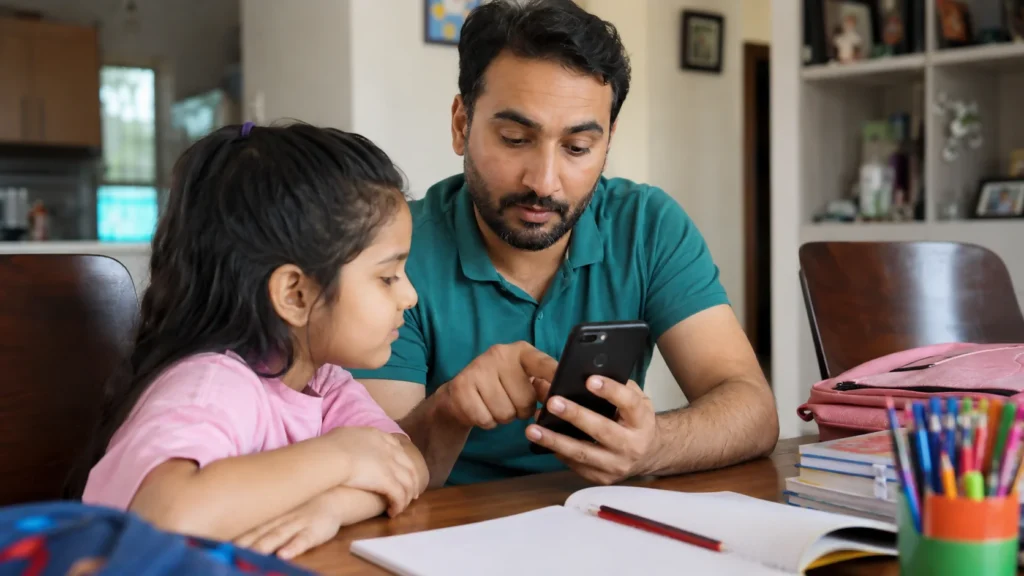
A free SIM card for a child is not automatically the safest option. For kids, the better question is not “Is it free?” It is “Can I control it, limit it, and rely on it when needed?”
When a free SIM makes sense for a child
A free or low-cost SIM may work well for:
- Emergency calls.
- Calling parents after school.
- A basic backup phone.
- Limited texting.
- A shared family device.
- A first phone with strict controls.
When a paid low-data plan may be safer
A free option may be a poor fit if it has unreliable coverage, unclear data limits, weak parental controls, or an app-based setup that the child can easily bypass. A cheap prepaid plan with predictable billing and parental controls may be safer than a vague “free unlimited” offer.
Safety settings before activation
Before giving a child a SIM-enabled phone, set up:
- A device passcode.
- Parent-managed app downloads.
- Web content limits.
- Location-sharing rules.
- Emergency contacts.
- Unknown caller filtering where available.
- Screen-time limits.
- A clear rule for lost phones.
- A rule for school hours and bedtime.
For iPhone, use Apple’s Screen Time and parental-control settings. For Android, use Google Family Link or built-in parental controls where available.
Free SIM Card Red Flags and Scams
Free phone-service searches attract misleading ads and fake government-style offers. Slow down if the offer pressures you to act immediately or asks for sensitive information before proving it is legitimate.
The FTC warns that government impersonation scams may claim you will miss a government benefit unless you pay, share personal information, or follow suspicious instructions.
Avoid these red flags:
| Red flag | Why it matters |
| “Guaranteed free government SIM for everyone” | Lifeline has eligibility rules and provider availability limits. |
| Application fee for a government benefit | Verify the process through official sources before paying anything. |
| No terms page | You cannot confirm data limits, fees, or cancellation rules. |
| No provider name | You cannot verify coverage, plan details, or support. |
| Requests for SSN or benefit information on an unofficial page | Sensitive data should only go through official or verified provider channels. |
| “Unlimited free data forever” with no details | Legitimate plans should explain high-speed data, throttling, and restrictions. |
| Door-to-door pressure | Verify the provider before sharing documents or personal information. |
If a page claims to offer Lifeline service, check it against official Lifeline resources and the provider’s own terms before submitting personal information.
Best Low-Cost Alternatives If You Do Not Qualify for Free Service
If you do not qualify for Lifeline and cannot find a trustworthy free-service option, a low-cost prepaid plan may be the better decision. It is not free, but it can be clearer, safer, and easier to cancel.
| Option | Best for | Main advantage | Main limitation |
| Lifeline-supported provider | Eligible households | Can reduce monthly phone cost | Eligibility required |
| Free carrier SIM promo | BYOD users | SIM card or eSIM may cost $0 | Service usually costs money |
| App-based phone service | Light talk/text users | May offer free calling/texting | Data and app limits |
| Cheap prepaid SIM | Non-eligible users | Predictable monthly plan | Not free |
| Low-cost eSIM | Newer iPhone/Android users | Fast setup, no shipping | Device support varies |
| Kid-friendly prepaid plan | Parents | Better controls and billing predictability | Monthly cost |
For most non-eligible users, the smartest move is to compare the total first-month cost, not just the SIM cost. A “free SIM” with a higher monthly plan may be worse than a low-cost SIM kit with a cheaper plan.
Final Recommendation: Which Free SIM Card Option Should You Choose?
Start with the reason you need the SIM.
If you need free or discounted monthly service, check Lifeline eligibility first through the official process. Lifeline is the most legitimate federal benefit to check, but availability and exact provider offers vary by location.
If you only need a free SIM or eSIM for an unlocked phone, compare carrier BYOD offers and check the full checkout page before ordering. The SIM may be free while the plan is paid.
If you want unlimited data, read the fine print. Look for high-speed data caps, throttling, hotspot rules, taxes, and renewal pricing.
If the SIM is for a child, prioritize parental controls, coverage, and predictable limits over a “free” headline.
If you do not qualify for free service, compare low-cost prepaid and eSIM plans. Paying a small, predictable monthly amount is often better than signing up for a confusing free offer with unclear limits.
FAQs
Can I get a free SIM card with free service?
Yes, but only in certain cases. Eligible users may get discounted service through Lifeline, and some providers or app-based services may advertise free or $0 options. Always check whether the SIM, activation, monthly service, taxes, and data are actually included.
Does Lifeline give you a free SIM card?
Lifeline itself is a federal benefit program, not one single phone company. Some Lifeline providers may offer a free SIM card to approved customers, but the exact SIM, phone, service, and data terms depend on the provider and location.
Is there a free SIM card with unlimited data?
Be careful with this claim. Some plans use “unlimited” to describe talk and text, while data may be limited, slowed after a threshold, restricted to certain apps, or tied to a promotion. Check the provider’s current terms before signing up.
Can I get a free eSIM card with free service?
A free eSIM may be available from some carriers or providers, but free eSIM activation does not automatically mean free monthly service. Make sure your phone supports eSIM and confirm whether the plan itself costs money.
Can I get a free SIM card for iPhone?
Yes, if your iPhone is unlocked, compatible with the provider, and supports the SIM type being offered. Newer iPhones may support eSIM, while older models may need a physical SIM. Check the provider’s IMEI or compatibility tool before ordering.
Can I get a free SIM card for Android?
Yes, but Android compatibility varies by model. Check whether your phone is unlocked, whether it supports the carrier’s network, and whether it uses physical SIM, eSIM, or both.
Can kids get free SIM cards?
A child may be able to use a free or low-cost SIM, but parents should check coverage, data limits, parental controls, emergency contacts, unknown caller settings, and app restrictions before activation.
Do I need an unlocked phone for a free SIM card?
Usually, yes. A locked phone may not work with another carrier’s SIM. Before ordering, check whether your phone is unlocked and use the provider’s IMEI compatibility checker.
Are free SIM card offers safe?
Some are legitimate, but others are misleading. Use official carrier or Lifeline provider pages, avoid pressure tactics, check the terms page, and do not enter sensitive personal information on unofficial pages.
Resources:
Lifeline Support — About Lifeline
Lifeline Support — How to Qualify
FCC — Affordable Connectivity Program
FTC — Government Impersonation ScamsApple Support — Set up eSIM on iPhone