Embodied AI Explained With Examples

In this story

Embodied AI is artificial intelligence that uses a body to sense and act in an environment. The body can be a robotic arm, a vehicle, or a simulated robot. Its actions change what happens next. A robot that reaches for a package can check whether it has a grip and adjust if the package slips. That feedback loop is what makes the example embodied.
The body shapes the task. A camera can help locate a box, a force sensor can detect contact, and the gripper determines what the robot can hold. A program that recognizes a box from a photo solves one part of the problem. A system that picks it up also has to manage position, movement, and feedback. Stanford HAI’s definition of embodied AI.
How the body changes what the AI can do
A wheeled robot can move through a room and get a new view when an object is hidden. A fixed arm can reach only within its workspace, but may position a gripper more precisely there. Two systems can understand the same instruction and need different movements to carry it out. This is one reason a demonstration on one robot tells you relatively little about performance on another.
Sensors also differ in what they can tell a system. A camera can reveal a label or a shape. A force sensor can reveal contact or resistance that the camera misses. The same distinction between a physical signal and what a system infers from it comes up in other fields. Our guide to biosensors explains it using health and laboratory examples.
Read more:
How to Get Your Business on ChatGPT
A worked example of embodied AI at a packing station
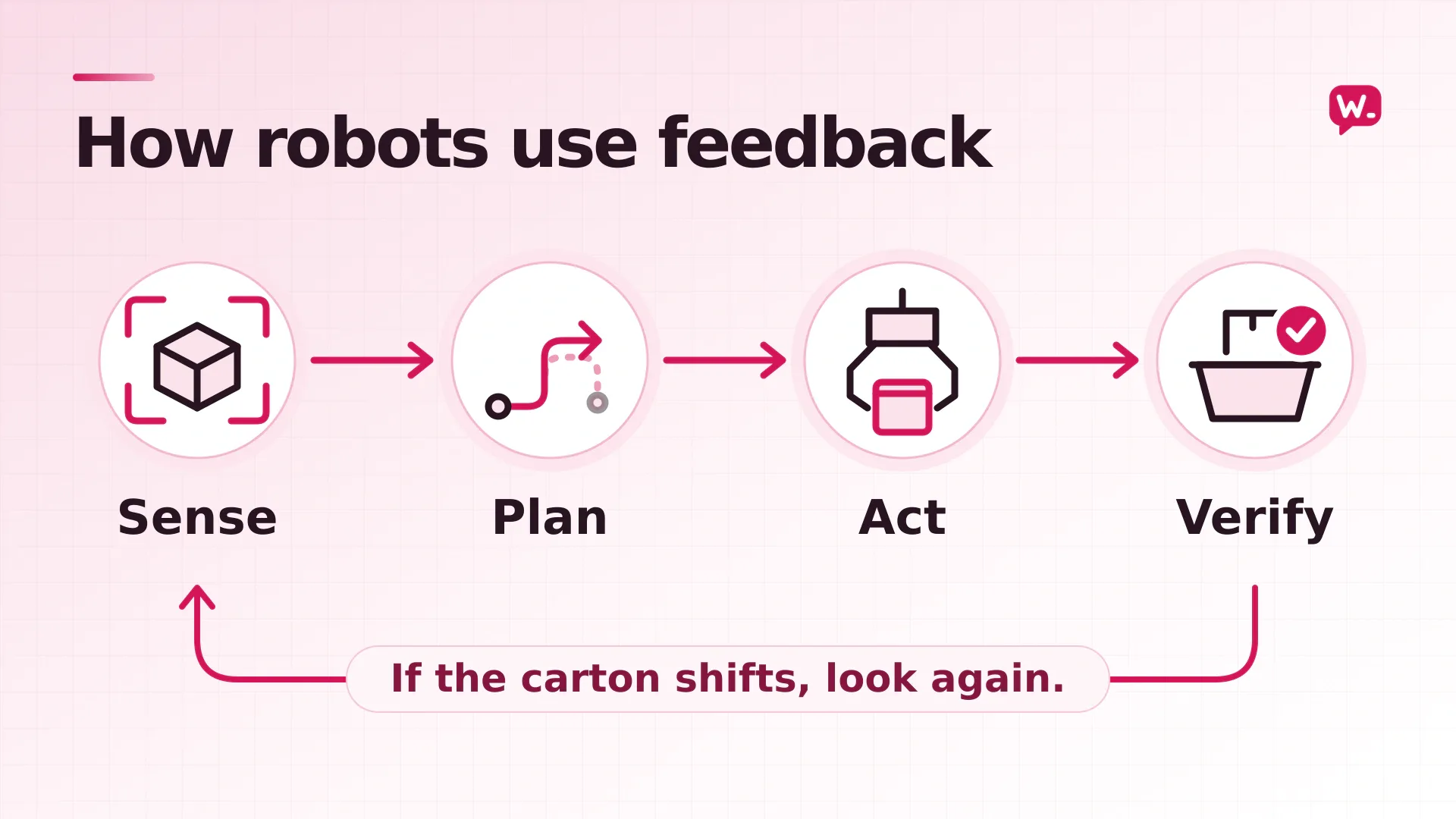
Imagine a robot assigned to move a small cardboard carton into a blue tote. In this illustrative example, the robot starts with a camera view and an instruction. It must locate the carton, find the tote, and choose a movement its arm and gripper can perform. Once it acts, it gets new information about how the attempt went.
When the carton shifts
Suppose the carton moves sideways as the gripper makes contact. The new camera view or grip feedback can show that the first attempt failed. The system can take another observation and choose a different approach within its permitted workspace. If it still cannot identify the carton or confirm a secure grip, it can stop and ask for help. Stopping is a distinct outcome worth measuring alongside successful retries.
How the robot knows the task is done
A command to open the gripper only tells you what the robot attempted. To verify the result, the system needs evidence that the carton is in the intended tote. For example, an updated camera view could show the carton inside it. Which checks are possible depends on the sensors and what they can observe.
This is closed-loop control. The robot uses new observations to decide whether to continue, correct its movement, or finish. A conventional controller can also use feedback, for example to keep a motor at a target position. The AI in the packing example addresses decisions such as recognizing the carton and adapting the next move to a changed scene.
The same instruction can become ambiguous if two cartons look alike or a label faces away from the camera. A new view might resolve the ambiguity, depending on where the camera is mounted. If the instruction is to move a particular carton, getting any carton into the tote would be a placement success and a task failure. The verification step has to check the item as well as the destination.
Embodied AI examples in warehouses, labs, and simulation
Warehouse picking with touch feedback
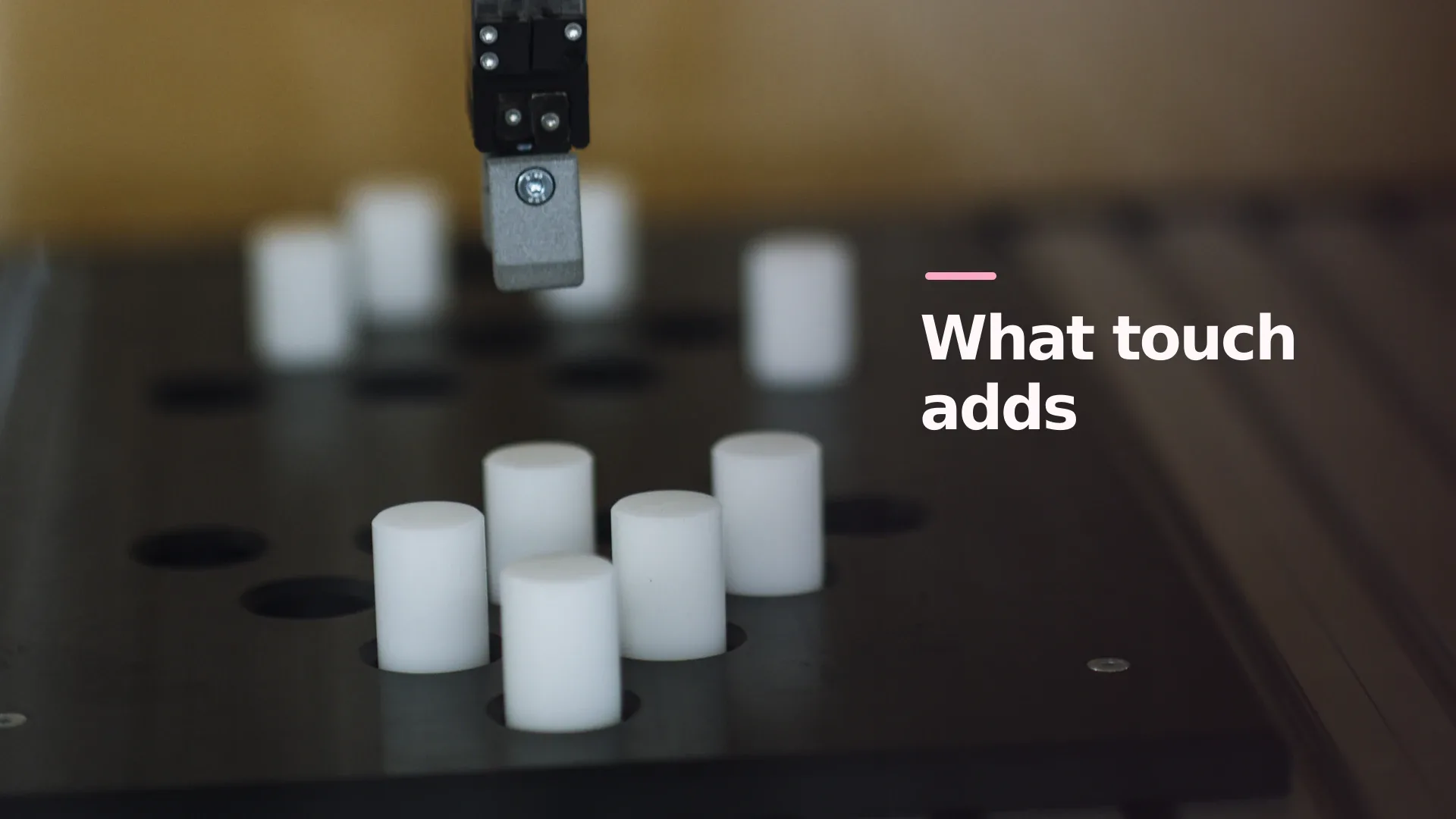
Amazon describes Vulcan as a fulfillment robot that uses force feedback when handling items in storage compartments. The sensors help it detect contact and measure how hard it is pushing. That is valuable when a camera cannot tell how tightly items fit together. This example shows the value of adding a specific sensing capability for a narrow job. Amazon’s description of Vulcan.
Robot arms that respond to language and movement
Google DeepMind’s Gemini Robotics research shows how a vision-language-action model can connect camera images and natural-language instructions to robot actions. The team reported examples of the system adjusting when an object was moved or slipped. These demonstrations show the types of changes the researchers tested. A buyer would still need evidence for their own objects, surroundings, and expected workload. Google DeepMind’s Gemini Robotics demonstrations.
Simulated robots that follow or work with people
Habitat 3.0 lets researchers study agents in simulated indoor spaces. In its social navigation task, a simulated robot locates and follows an avatar. In its social rearrangement task, agents work together to change a scene. The agent has a viewpoint and permitted movements, and each action changes its next observation. That makes the experiment useful for studying embodied behavior before testing it on physical hardware. Habitat 3.0 research paper.
How embodied AI learns to act
One method is imitation learning. Researchers collect demonstrations, often by having a person operate a robot, and train a policy to choose actions from observations. A policy is the part of the system that selects what to do next. The DROID project collected real robot manipulation demonstrations across many scenes, an approach that gives researchers varied examples to train on. The DROID research paper.
Another approach uses simulation to generate experience. In a simulator, researchers can change lighting, object placement, or friction across trials. The differences between the simulator and a physical robot create a sim-to-real gap. A study on randomized simulated dynamics showed transfer to a real robot on a specific object-moving task. That result illustrates why varying conditions can help and why testing on real hardware still matters. The sim-to-real study.
Where vision-language-action models fit
A vision-language-action model, or VLA, can take visual observations and language as inputs and produce actions for a robot. In the packing example, language supplies the goal and the image helps locate the carton. The robot’s hardware and control system carry out the movement. A VLA is one approach to an embodied system. Other designs divide perception, planning, and control into separately built components. Google DeepMind’s RT-2 explanation.
Does a robot learn every time it adjusts?
A trained policy can choose a new action from a new observation during the same task. The model can do that with the same parameters it started with. Learning from a failed attempt requires a process that changes the policy, which could happen later when a team uses logged examples to improve the model. When a demo says a robot adapted, check whether the team means an immediate change in behavior or an update that will affect future tasks.
Embodied AI, physical AI, and software agents
Term | What it emphasizes | Example |
Embodied AI | An agent’s actions and observations through a body. The body can be real or simulated. | A simulated robot following an avatar. |
Physical AI | Systems that sense and act in the physical world. The term often overlaps with embodied AI in robotics. | A robot handling items in a fulfillment center. |
Software agent | An agent that can take steps through digital tools or interfaces. | A browser agent comparing information across websites. |
Labels vary across researchers and companies. Follow the actual observation and action in the example. A browser agent can observe a webpage and click a control, as our guide to ChatGPT agent mode describes. A robot arm can observe and move a physical object, with outcomes shaped by its reach, grip, and surroundings. IBM’s physical AI overview.
How to read an embodied AI demo
Start by writing down the task and what would count as success. For the packing station, the goal is a carton in the correct tote without damage or human intervention. Then look for a test that separates a clean first attempt, a successful recovery, and a human handoff.
What to check | Question to ask | What the answer tells you |
Range of conditions | Were the carton, tote, and lighting varied? | Whether the result covers the situation you care about. |
Autonomy | Did a person steer the robot, restart it, or intervene? | How much work the system completed on its own. |
Failures and recovery | Did the report include retries, drops, and safe stops? | Whether it handled surprises and how often they occurred. |
Time and throughput | Does the timing include retries and handoffs? | How the task might fit into an ordinary shift. |
Why the denominator matters
Imagine a report covers 100 attempts. The robot gets 82 right on the first try, recovers on its own in 12, and hands off six. First-pass success is 82%. Autonomous completion is 94% because it includes the 12 recoveries. If a person finishes all six handoffs, every carton can reach the intended tote, while the robot’s autonomous rate stays at 94%. These figures are illustrative. They show why “completed” needs a definition.
Read the evaluation conditions before comparing two numbers. Look for the exact hardware, which objects were unfamiliar, and whether the setup was a lab, a simulation, or a working site. If a summary makes a broader claim than the paper, our source-check exercise offers a way to trace that claim to the original evidence.
When you watch an embodied AI demo, look for the moment the world changes. An object shifts, someone steps into view, or a grip fails. What the system observes and does next tells you more about the job it can handle than a flawless run under ideal conditions.
Keep reading


Colette Kress and Nvidia’s Future After Jensen Huang
Colette Kress takes over Nvidia at a critical point in the AI buildout. Her record shows how she may handle the Rubin rollout and Nvidia’s growing exposure to customer financing.


Jensen Huang Resignation: Why He Left NVIDIA and Who Takes Over
Jensen Huang has stepped down as NVIDIA’s CEO. Here is what is known about the intelligence inquiry, workplace report, and interim successor Colette Kress.
What Is Humanoid Robot Design?
Humanoid robot design is the engineering of a robot with a humanlike body or upper body. It brings together a frame, movable joints, sensors, power, and control...