What Is Humanoid Robot Design?

In this story
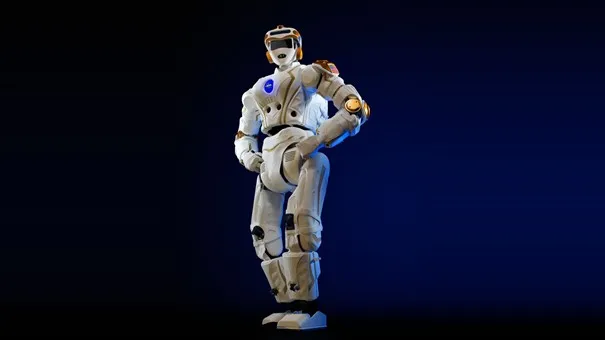
Humanoid robot design is the engineering of a robot with a humanlike body or upper body. It brings together a frame, movable joints, sensors, power, and control software. The purpose is to give the robot useful ways to reach, carry, or move through a space built around people. A humanoid can have two legs, a wheeled base, or a torso mounted at a workstation.
The design starts with the job. A robot meant to carry totes across a warehouse needs to reach the pickup and drop-off points with a load. One meant to operate equipment may need fingers that can grip a handle or press a button. The two jobs can call for different bodies, even if both robots look humanlike above the waist.
Why give a robot a humanlike shape?
Workbenches, doors, and many tools are built around human height and reach. A torso with two arms can approach some of those fixtures from familiar angles, and one arm can steady an object while the other moves it. NASA designed the electric Valkyrie research robot for the 2013 DARPA Robotics Challenge trials, which emphasized operating in human-built environments. NASA’s Valkyrie overview.
Human proportions are one design option. A clear aisle and a standardized tote can make a wheeled base and a specialized gripper practical. A station that stays within reach can be served by a fixed arm. The useful question is which parts of the human form help with the work.
Related Posts:
The parts of a humanoid robot
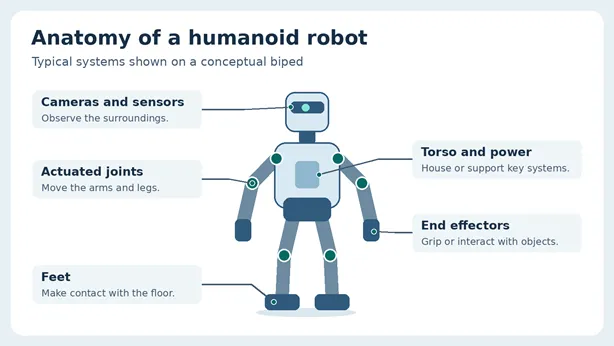
Frame, joints, and actuators
The frame carries the robot’s own weight and the loads it handles. Joints give its limbs a way to move. An actuator supplies motion or force at a joint, such as an electric motor turning an elbow through a transmission. A degree of freedom is an independent way a configuration can change. A simple hinge has one, while an assembly of joints can let a wrist approach an object at several angles. More degrees of freedom give a controller more choices and add motions it must coordinate. Modern Robotics on degrees of freedom.
Sensors, control, and power
Cameras and depth sensors can help locate objects. Joint encoders measure joint position, an inertial measurement unit helps estimate orientation and movement, and force sensors can reveal contact. A controller combines measurements to estimate the robot’s state, then updates motor commands. Our biosensors explainer shows how another class of sensors turns a physical or chemical event into a reading.
A battery adds weight that the robot carries every time it moves. Designers have to account for the time a robot spends walking, lifting, waiting, and charging. A runtime figure is most useful when you know the task and load used to measure it.
Choosing legs, wheels, hands, and grippers
What makes two-legged balance difficult?
A biped has to manage its body weight and momentum while the points supporting it change. During a step, it may be supported by one foot. A heavy tote held forward can shift the combined center of mass and make a reach harder to control. Dynamic walking depends on the movement of the body and where the next foot lands. Engineers evaluate the floor, the motion, and the load together. MIT’s notes on legged robot control.
Legs can be useful when a route requires steps or changes in floor height. Confirm that the specific robot has demonstrated those transitions with the load it will carry. On a flat route, a wheeled platform can avoid the repeated balancing and foot placement required by walking. It still needs enough traction and stability for its turns, stops, and reaches.
Pepper is an example of a humanoid with a wheeled base. It has a head and arms for interacting with people. The maker’s software documentation describes how the robot combines wheel speed with readings from a gyroscope in its base to improve movement estimates. The wheels change the control problem, and the upper body still supports humanlike gestures. Aldebaran’s notes on Pepper’s movement.
When does a robot need a hand?
The part that touches an object is called the end effector. A hand with independently moving fingers can support several types of grip. A gripper shaped for a tote’s handles can simplify a repetitive pick. That tradeoff matters when the job changes. A gripper designed for a rigid handle may struggle with a soft bag, while a hand built for varied objects adds motions to coordinate and more parts to maintain.
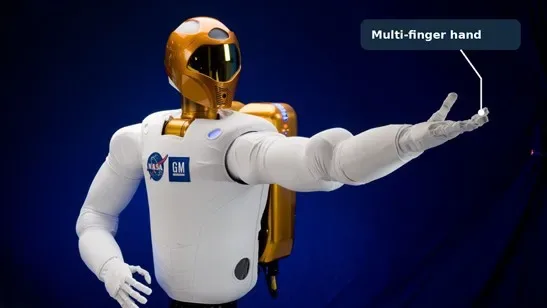
Robonaut 2 photograph by NASA and Robert Markowitz. Cropped and annotated.

NASA’s Robonaut 2 used humanlike arms and hands for work with equipment designed for astronauts. It first operated on the International Space Station as a torso on a fixed mount. NASA later added two climbing legs for moving inside the station. The same upper-body design could be paired with different ways of supporting and moving the robot. NASA’s Robonaut 2 overview.
A worked example of designing for a warehouse tote
Imagine a robot that must move a 4-kilogram tote from a cart to a conveyor. Before choosing a body, record the pickup height, drop-off height, handle shape, clearance, and the entire travel route. Those details determine how much reach and motion the robot needs. They also show where a simpler layout might be enough.
If the work looks like this | Start by evaluating | What to check |
Cart and conveyor sit within one station. | Fixed arm with a tote gripper | Reach at both heights, handle alignment, and cart positioning. |
Pickup and drop-off are separated by a smooth aisle. | Wheeled mobile manipulator | Aisle width, approach angle, turning room, and stability with the tote. |
The route includes a step that the workflow must retain. | Bipedal humanoid | Whether it can cross the step with the tote and place it at the required height. |
Why holding the same load farther out matters
Consider a stationary, simplified hold. With the tote’s center of mass 0.30 meters horizontally from a joint, its weight contributes about 11.8 newton-meters of torque about the relevant axis. At 0.60 meters, the contribution rises to about 23.5 newton-meters. The calculation multiplies the 4-kilogram mass by Earth’s gravitational acceleration of about 9.81 meters per second squared, then by the horizontal distance.
The example isolates the tote’s contribution. An actual robot also has to account for its arm and gripper, the direction and speed of motion, and the effect on whole-body balance. When reading a payload specification, look for the reach, pose, and motion associated with it. Modern Robotics on force and torque.
Look at pickup and placement as separate moves. A tote may be easy to lift from a cart at waist height and harder to place deep onto a conveyor, where the arm must reach farther. If the receiving surface can move closer, that change may reduce the mechanical demand without changing the robot. It is worth checking the layout before comparing maximum payload figures.
What a real deployment tells you
GXO reported deploying Agility Robotics’ Digit to move totes from other robots onto conveyors at a facility serving SPANX. That report gives you a defined job and the equipment on either side of it. For a different facility, check whether the tote, route, and handoff are similar enough to make the example relevant. GXO’s Digit deployment announcement.
How to judge a humanoid robot demo
A video can show that a robot completed a movement in one setup. For a fuller picture, look for repeated runs under conditions that resemble the intended job. A tote demonstration is more informative when it includes different tote weights, small variations in cart placement, and the time spent resetting between attempts.
Check which parts the robot controlled
Ask whether a person operated the robot, the system followed a predefined sequence, or the robot chose how to proceed from its sensors. A teleoperated demo can show that the hardware has useful reach and grip. An autonomous run also tests whether the system can decide what to do and verify the result. Keep those claims tied to the mode the team actually used.
A software agent can also choose and execute steps, as our guide to ChatGPT agent mode describes for browser tasks. A robot adds physical requirements such as balance and grip. A model that understands the instruction still needs a body that can carry it out and a controller that can respond to changes.
Check what the demo reports about failures
Look for how many attempts it took, how often a person helped, and how the system responded when a tote was out of place. A stop or handoff can be appropriate when a grip fails or a route is blocked. The important distinction is whether those events were recorded and included in any published completion or throughput figure. Our source-check exercise shows how to trace a performance claim back to the original evidence.
Does a humanoid robot need generative AI?
A humanoid can use predefined motions, sensor feedback, or remote control. Some newer systems also use learned models to interpret instructions and help select actions. A robot can combine those approaches in one job. For example, a model might identify which tote to pick while a conventional controller keeps the joints on the chosen path. Each part needs to be evaluated against the job it performs.
Keep reading


Colette Kress and Nvidia’s Future After Jensen Huang
Colette Kress takes over Nvidia at a critical point in the AI buildout. Her record shows how she may handle the Rubin rollout and Nvidia’s growing exposure to customer financing.


Jensen Huang Resignation: Why He Left NVIDIA and Who Takes Over
Jensen Huang has stepped down as NVIDIA’s CEO. Here is what is known about the intelligence inquiry, workplace report, and interim successor Colette Kress.
Embodied AI Explained With Examples
Embodied AI is artificial intelligence that uses a body to sense and act in an environment. The body can be a robotic arm, a vehicle, or a simulated robot. Its...