What Is Artificial Superintelligence (ASI)? If AI Becomes Smarter Than Us, What Will Still Make Humans Valuable?
Work, education, creativity and the right to a meaningful life. Artificial superintelligence (ASI) would surpass the best human minds, but our dignity does not depend on winning an intelligence contest.


In this story
Artificial superintelligence (ASI) is a hypothetical AI that would surpass the best human minds across a broad range of intellectual tasks. [1] If AI becomes smarter than us, humans will still be valuable: our dignity does not depend on winning an intelligence contest, and our relationships, choices and creative lives matter. The practical challenge is to protect those things—and people’s livelihoods—as machines take on more work.
Imagine a customer-support worker faced with a difficult question. An AI assistant offers a useful suggestion, and the worker resolves the issue sooner. Now multiply that moment across a company. In a real rollout involving 5,172 support workers, access to an assistant raised the average number of issues resolved per hour by 15%. The study did not measure layoffs or show who received the gains. [3]
Now picture someone applying for their first support job. The company can serve more customers, yet it may offer fewer junior openings. That second scene is a possibility, not a finding from the study. It captures the decision the productivity figure cannot answer: will the gains mean better service, higher pay, shorter hours or fewer entry routes? As AI grows more capable, those choices will affect who gets a place in the future it helps build.
What is ASI, and does it exist today?
Three terms help keep this discussion honest. AI is the broad category of machine intelligence. Artificial general intelligence, or AGI, usually means broadly capable intelligence at roughly human level, although definitions and tests differ. ASI goes further: it would outperform even exceptional humans across many intellectual domains. Winning at one game or producing a fluent answer is not enough. Nor would superhuman performance automatically imply consciousness, wisdom or concern for people. [1]
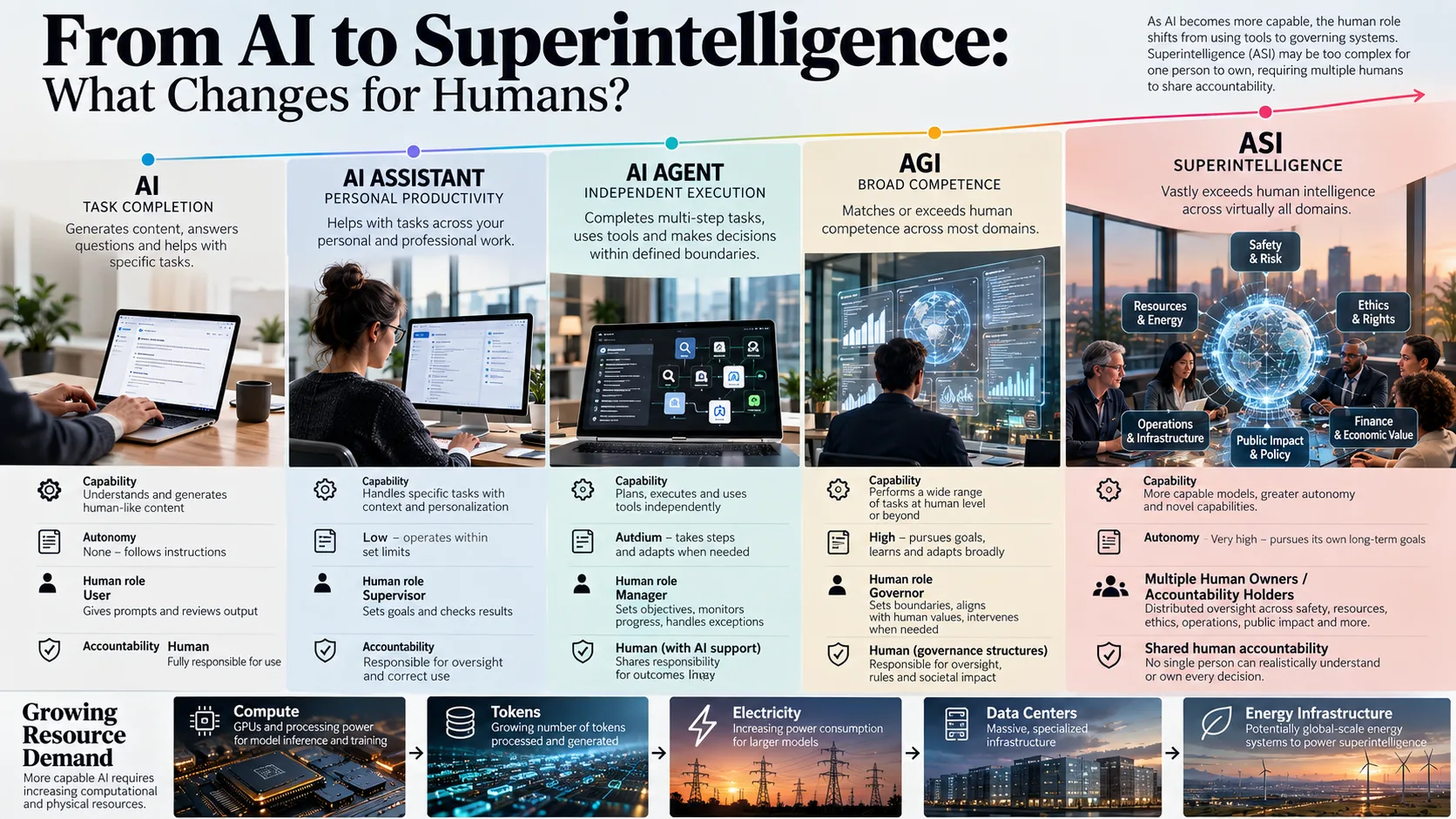
No broadly accepted public evidence establishes that ASI exists today. The International AI Safety Report 2026 describes rapidly advancing systems alongside uneven performance, unreliable behaviour and major uncertainty about future progress. It does not establish a dependable date for superintelligence. [2]
Even genuine ASI would not mean that everything becomes instantly possible. Designing a better hospital and building one are different achievements. Energy, materials, land, institutions and physical deployment would still matter. Superior problem-solving would also leave disagreements about acceptable risks and fair treatment unresolved.
There are two questions here: could machines become much smarter than us, and could we reliably direct that capability towards human welfare? Progress on the first does not settle the second.
We do not need an ASI arrival date to prepare. Today's systems already let us study what happens when a specific human task becomes easier to perform.
Will AI replace jobs? What the evidence tells us so far
The customer-support study also shows why a headline average can mislead. Less experienced workers improved both speed and quality. The most experienced workers saw smaller speed gains and small declines in quality. The researchers found evidence of learning among workers and fewer requests from customers to speak to a manager. One rollout produced several different effects; a company should measure quality and learning as well as speed. [3]
The distinction matters. Faster work can lead to lower prices, more customers, shorter hours or fewer employees. Demand, costs and management decisions determine the outcome. Productivity alone cannot tell a worker whether their job is safe.
The International Labour Organization and NASK estimated in 2025 that one in four workers worldwide were in occupations with some exposure to generative AI, while 3.3% of global employment fell into their highest exposure category. Exposure measures potential effects on tasks. It does not mean one in four workers will lose their jobs. Their assessment pointed towards job transformation as the more likely outcome for most exposed occupations under the technology examined. [4]
In my work and in following large technology, SaaS and e-commerce companies, I have seen a troubling pattern: teams improve the quality and speed of what they deliver while sharply reducing junior hiring. Experienced candidates still appear in hiring plans, but the first chance has become harder to find. This is my observation across the businesses I know, not a claim that AI alone caused every hiring decision.
The wider evidence makes the concern harder to dismiss. A Stanford Digital Economy Lab analysis of US payroll data through June 2026 found no economy-wide displacement, but employment among 22- to 25-year-olds in highly AI-exposed occupations was 19% below where it would have been if it had kept pace with similarly aged workers in less-exposed occupations. The difference appeared mainly in hiring rather than layoffs. The authors call these descriptive patterns, not a causal estimate of AI's effect. [11] A separate study of US software job postings estimated a 14–15% relative decline in junior versus senior developer vacancies after ChatGPT's release; that finding concerns software development, not every industry. [12]
This creates a problem even for employers who keep their experienced staff: where will the next generation learn? Junior work has often been the training ground for judgement and responsibility. If AI performs the first drafts and routine checks, companies need supervised projects and deliberate mentoring to replace the learning those tasks once provided.
For someone deciding what to learn, the useful unit is therefore the task. A job title can conceal work that is easy to automate alongside work requiring physical presence, local knowledge, trusted relationships or responsibility for consequences.
Those advantages can change. “AI-proof career” is an unsafe promise. A more useful question is: which part of this job is becoming cheap, and which part still limits the quality of the result?
For example, if generating a marketing report becomes cheap, its value may move towards obtaining reliable customer evidence and deciding what to change. Producing more pages is not necessarily progress. Finding one costly mistake could be. That example is an inference about a possible workflow, not a measured prediction about marketing jobs.
My forecast: an unequal transition in uneven waves
I expect neither an overnight end to work nor a smooth adjustment in which everyone simply learns new tools. My forecast is an uneven transition: some tasks disappear quickly, some jobs expand, and some people face falling income while the economy around them grows.
This is a judgement, not a scientific prediction. I would revise it if the evidence changed. Three futures are worth watching:
| Possible future | What would make it more plausible? | What to watch |
|---|---|---|
| AI broadly assists workers | Tools spread widely; demand grows; gains reach employees | Higher output alongside stable employment, better pay or shorter hours |
| Gains concentrate among owners | Automation outpaces worker transitions; competition and bargaining weaken | Higher profits alongside weaker hiring, wage pressure and fewer entry routes |
| Paid work becomes less necessary | Reliable automation extends widely, including physical work; public institutions share the gains | Sustained reductions in necessary working hours with secure living standards |
Different industries and countries could experience these futures simultaneously. At the support desk from the opening, growing customer demand might keep the whole team employed; flat demand and a decision to cut costs might lead to fewer shifts. The research does not tell us which choice that employer made. A small business with affordable tools may gain opportunities while another company cuts entry-level roles and removes a route into a profession.
Access will also depend on infrastructure. The World Bank’s 2025 AI foundations report stresses connectivity, computing capacity, locally relevant context and skills. A country cannot distribute opportunities that unreliable electricity, unaffordable access or missing language support prevent its citizens from using. [5]
The practical response is to watch outcomes, not demonstrations. Can people find good work? Are essential services improving? Can small organisations compete? A more impressive model does not answer any of those questions by itself.
How can people share the gains if AI does more work?
I would like a future in which more of life is available for friendship, creativity, care and enjoyment. But “we will not need to work” contains a missing step: how will people obtain what they need if wages become less reliable?
Cheap production does not automatically give people purchasing power. Ownership still matters. My preferred response is universal basic services first, with an AI public dividend on top as sustainable revenues permit. If a support worker loses their job, accessible healthcare and education help them through the transition; a reliable share of economic returns could give them more choice about what to do next. This is a proposed social arrangement, not a claim about the workers in the study.
The services would establish dependable access to essentials such as healthcare, education, basic connectivity and housing support. The dividend would give people additional spending freedom through a share of publicly captured economic returns. I would not make essential services depend on volatile annual AI profits.
This proposal needs honest funding choices. Governments could consider stronger enforcement of taxes on corporate and capital income, or independently governed public investment funds where suitable. In some cases, public support for commercial development could include an agreed public return. Each route has costs, legal constraints and risks; none produces free money.
The IMF has argued for stronger social protection and capital-income taxation while cautioning against a special tax on AI that could discourage useful investment. That supports examining how gains are distributed; it does not amount to endorsement of my particular services-and-dividend proposal. [6]
Alaska’s Permanent Fund Dividend offers a limited precedent for distributing shared investment earnings to eligible residents. It is funded through a particular resource and investment system, not AI, and does not demonstrate that a dividend can replace wages or fund a whole welfare state. [7]
Three objections deserve serious answers. First, cash cannot solve shortages of homes, nurses or electricity. Public investment must expand supply where capacity is the problem. Second, governments can mismanage money or use benefits to control citizens. Transparent accounts, independent audits, appeal rights and limits on political interference are essential. Third, countries differ enormously in fiscal capacity. A workable transition may begin with portable benefits, accessible training and reliable basic services rather than an ambitious universal payment.
Necessary human work must still be rewarded. A society that celebrates leisure while underpaying the people who provide care has not solved its problem.
What angers me is the instruction to displaced workers to “adapt” without a serious discussion of who receives the gains. A company can have good reasons to reorganise. It should still account for the people who carried the business before the tools changed. Public policy must address workers who cannot simply move to a new role next month. Anger should push us towards workable institutions while acknowledging real scarcity.
An AI Inclusion Hierarchy: access is only the beginning
Giving someone an AI account is a weak measure of inclusion. They may still lack a secure home, the knowledge to challenge an answer or the power to appeal a decision affecting their livelihood.
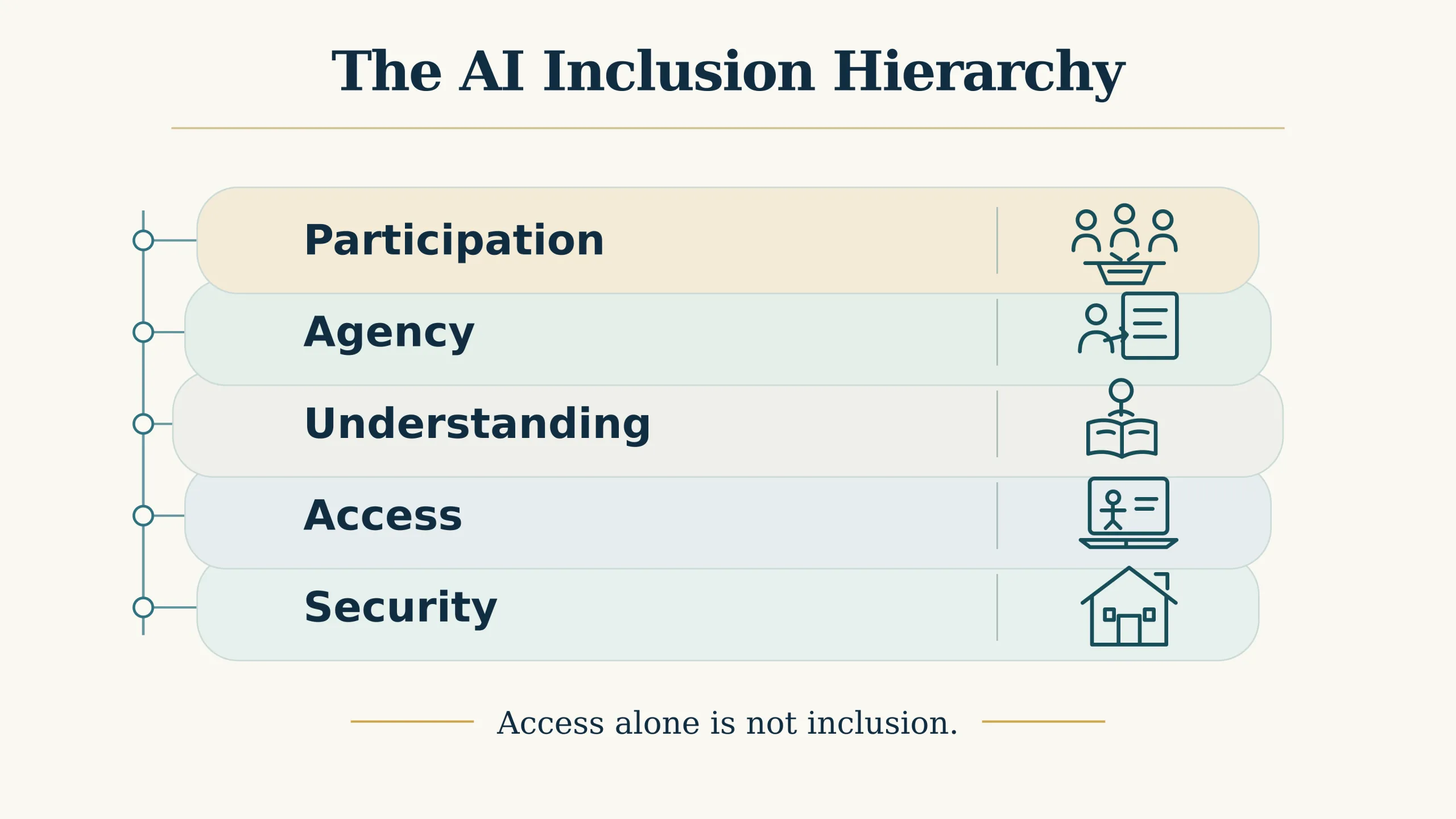
I propose an AI Inclusion Hierarchy, loosely inspired by Maslow’s attention to human needs. This is my practical framework, not a validated psychological model. Its layers overlap: people must not wait for financial security before receiving a voice or basic rights.
| Dimension | What inclusion requires | A useful test |
|---|---|---|
| Security | Essentials and support through disruption | Can a person refuse unsafe work without losing access to basic needs? |
| Access | Affordable tools, connectivity and accessible design | Can they actually use the service in their language and circumstances? |
| Understanding | Education and help evaluating outputs | Can they recognise uncertainty and seek independent advice? |
| Agency | Meaningful choices, appeal and accountability | Can they challenge a harmful decision and reach someone able to change it? |
| Participation | Opportunities to create, contribute and influence rules | Can they shape the system, rather than merely consume its outputs? |
Consider a hypothetical city using AI to help administer housing support. An online chatbot might improve access. Yet if an applicant cannot correct a mistaken record, cannot reach an accountable official, or loses assistance while an appeal waits, the service fails the agency and security tests.
A better evaluation asks whether eligible people receive support accurately and promptly, whether appeals are resolved, and whether people with disabilities or limited connectivity can participate. Counting chatbot conversations would tell us far less.
This framework is useful for employers and schools too. Before calling an AI rollout successful, ask which dimension improved and which might have deteriorated. Speed is one result. Inclusion requires more evidence. It also depends on what we mean when we say a person is “valuable.”
If AI becomes smarter than us, what will still make humans valuable?
We often combine three different ideas: market value, personal meaning and moral worth. A machine can reduce the price of a service without making the person who provided it less deserving of dignity.
My ethical starting point is conscious life: experiences can be joyful or painful, relationships can matter, and lives can go well or badly for the beings living them. Intelligence matters partly because it can improve those lives. It is not a licence to rank whose existence deserves protection.
This is not a test that individuals must pass. Infants, people with profound disabilities and people temporarily unable to express awareness retain their dignity and rights. Human protection must never depend on demonstrating intelligence, productivity or a particular level of consciousness. Whether future machines could have experiences deserving moral consideration is a separate, unresolved question; it would not erase our obligations to people.
There is also a straightforward answer about meaning. Your friend may want your company even if a machine tells better jokes. You may want to raise your child, tend a garden or play an instrument without being the most efficient person—or system—available.
Such activities do not need to outperform a commercial alternative to be worthwhile. The harder problem is economic: meaningful relationships do not pay the rent. That is why dignity needs the material arrangements discussed above. It also needs education that keeps people capable of directing their own lives.
I also resist the idea that everyone must become an entertainer. I welcome more play and enjoyment. But an economy in which people must constantly attract attention to survive could turn leisure into another exhausting competition. Quiet people deserve security too. A meaningful future should leave room for lives that are never broadcast.
Why learn if AI can do the work?
If AI can answer the question, why learn the subject?
Because receiving an answer and understanding a situation are different abilities. Knowledge lets us notice omissions, ask better questions and recognise when an answer conflicts with the world. Without some internal understanding, even deciding which expert to consult becomes harder.
A 2025 study of nearly 1,000 high-school mathematics students in Turkey illustrates the risk. Access to a general GPT-based assistant improved performance during supported practice, but the group performed 17% worse than the control group when assistance was removed. This was a relative difference, not 17 percentage points. A tutor designed with learning safeguards avoided the same adverse effect on unaided performance. The finding concerns a particular intervention, not every AI tool or learner. [8]
There is positive evidence too. A study involving 194 Harvard physics students found that a carefully designed AI tutor produced greater immediate learning gains in less time than an active-learning class for the lessons studied. It did not establish that AI can replace a teacher or an entire education. [9]
Together, these results suggest a practical distinction: use AI to support the mental work that produces learning; be cautious when it simply removes that work.
For a student, that can mean attempting a problem first, asking for one hint, explaining the solution in their own words, and solving a different problem later without help. For a working adult, it can mean drafting a judgement before consulting AI, comparing the reasoning, then checking consequential claims against independent evidence.
Schools should assess both modes: what learners can achieve with tools and what they understand without them. Reading, numeracy and subject knowledge still matter. “We can look it up” is a poor substitute for knowing enough to recognise a misleading answer.
It would be a failure to celebrate polished assignments while quietly abandoning the development of capable minds. A child should leave school more able to question authority, including machine authority. If an AI-assisted grade hides the fact that a student cannot explain the result, the school has measured the finished page and missed the learner.
But cognitive independence does not mean each person must outthink a superintelligence. We already depend on specialists and institutions. The realistic aim is to retain enough understanding to make choices, and to build independent checking, accountable expertise and genuine appeal into the systems we rely on. The same principle applies to making art: assistance can be welcome without surrendering the activity itself.
Creativity deserves room for human imperfection
I want to keep control over the creative work I enjoy. Sometimes beauty is in imperfection: a voice that trembles, an uneven line, a story whose awkwardness reveals something real about its author.
AI may imitate those qualities. That does not make the human process meaningless. A handwritten note matters partly because a particular person chose to write it. An apparently identical output can carry a different relationship and history.
Research on art labels supports a limited version of this idea. In experiments using AI-generated paintings, participants generally evaluated work more favourably when it was labelled as human-created. The study shows that beliefs about origin can affect appreciation. It does not prove that human art is always preferred or that creative livelihoods are protected. [10]
My preference is for clearly defined human creative spaces alongside openly AI-assisted ones. A writing competition, school assessment or exhibition can state what it values and specify which tools are permitted. Audiences and participants should know when material generative assistance was involved.
Those rules need care. Accessibility tools, ordinary editing software and a model generating most of a work are different forms of assistance. Vague claims of “100% human” can exclude people unfairly or invite misleading marketing. Disclosure should explain the meaningful creative contribution, not demand surveillance of every keystroke.
For a creator, a practical response is to make the process part of the offering: show drafts, explain choices, perform live, involve clients or build a relationship around the work. These approaches may strengthen value for particular audiences; they are not an income guarantee.
I would also support spaces where creative activity needs no commercial justification: public workshops, community performances and opportunities to learn a craft. Human creativity should remain something people can practise, not a luxury reserved for those who can already afford security.
Human control must be more than a signature
Keeping a person “in the loop” sounds reassuring. It means little if that person lacks the time, knowledge or authority to refuse the system’s recommendation.
Meaningful control starts before deployment: define the purpose, restrict permissions and decide which consequences require additional scrutiny. Afterwards, people need records of what happened, a responsible organisation to contact and a practical route to correction.
For example, an AI system helping screen job applications should not leave a rejected candidate facing an explanation nobody can investigate. The employer needs a way to identify errors, review the process and change outcomes when warranted. This is a proposed standard of accountability, not a claim that every jurisdiction already requires it.
With ASI, the challenge could become much harder. Human approval alone would not establish that we understand or can control a vastly more capable system. Technical safety research, independent evaluation and enforceable limits would remain necessary; the 2026 safety report describes important limitations in existing risk-management methods. [2]
Who gets to direct it?
I do not think one person should hold unchecked power over a system that could manage work across businesses or public services. We would need a named operator responsible for its actions, with independent testing and public rules governing deployment, access to sensitive systems and expansion. Reviewers must be able to refuse or suspend a use. Giving the system several nominal “owners” would not help if they shared the same incentives or could pass blame around.
Who gets the electricity?
The resources are physical. “Tokens” measure model input and output; the services behind them require chips, data centres and electricity. The IEA estimates data centres used 485 terawatt-hours of electricity in 2025 and projects about 950 TWh in 2030 in its central outlook. That projection covers all data-centre activity, not AI alone or a future ASI. Local price effects depend on capacity and policy. [13]
Imagine a region considering a large AI facility while homes, hospitals and small firms also need reliable, affordable power. The facility could help fund new generation and grid upgrades. But residents should know who pays for those upgrades, how essential services are protected during shortages and who can require the facility to reduce demand. A company’s ability to pay should not quietly decide every priority.
Could a future autonomous ASI seek more computing power or energy to complete an assigned goal, perhaps resisting limits? That is a risk to investigate, not evidence that AI “craves” anything. The 2026 international safety report describes loss of control as uncertain in likelihood but potentially severe. [2] Limit access to infrastructure and money, test behaviour, and preserve the ability to revoke permissions. Human control needs technical teeth and accountable decisions about scarce resources.
We should distinguish using intelligence to pursue a chosen goal from giving that intelligence authority to decide which lives and interests count. Better optimisation cannot settle those moral choices for us.
A practical way to prepare over the next month
You do not need to bet your future on a particular ASI forecast. Start with actions that are useful across several possible futures.
Week one: map your work. Record five recurring tasks, how much time each takes, what a good result looks like and the cost of an error. Separate generating an output from checking it and acting on it. This will expose where assistance might help and where you still lack evidence.
Week two: run one bounded experiment. Choose a task with recoverable mistakes and use an approved tool with appropriate data. Compare several similar tasks with and without AI. Count review and correction time. If a task falls from 120 minutes to 80 minutes at comparable quality, that is a 33% time saving. This is an illustration, not a research finding. A fast draft that requires extensive repair may save nothing.
Week three: strengthen understanding. Choose one area important to your judgement and study it without outsourcing every step. Test yourself without assistance. Create a short checklist of consequential claims that need external verification. For matters beyond your expertise, identify who is qualified to help.
Week four: protect choice. Keep portable examples of your work, understand which tools and records you depend on, and invest time in real relationships. Choose one creative or practical activity to do yourself because the process matters to you. Review whether AI saved time—and decide deliberately what that time is for.
Employers can run a parallel test: publish what success means before adoption, measure errors as well as output, and explain how staff will share in gains or receive transition support. Track junior hiring alongside productivity. Give new staff supervised responsibility for checking AI output, talking to customers and learning how decisions are made. If the old entry-level tasks disappear, design a new apprenticeship rather than expecting experienced workers to appear from nowhere.
For public institutions, the priorities are broader: dependable services, access to education, competition, accountable deployment and credible arrangements for sharing prosperity. Individual adaptability helps, but it cannot substitute for decisions only institutions can make.
A future worth being smarter for
I do not know whether we will reach a world where paid work becomes optional. I would welcome more freedom to live, create and care for one another. I would not welcome dependence disguised as convenience, or entertainment offered as compensation for having no influence over our lives.
The future I want gives people enough security to refuse exploitation, enough education to question what they are told, and enough freedom to choose activities that machines could perform better.
If an AI can compose a technically superior song, I may still want to sing. If it can solve a problem instantly, I may still want to learn how. And if it can create more wealth with less human labour, the people whose labour becomes less necessary should share in that achievement.
The measure of progress is what greater intelligence makes possible for those living with it. If the support worker from the opening gains a better tool, a fairer share of its benefits and the freedom to build a life outside work—and the next applicant still has a way to learn and enter the field—that is progress I can recognise. If only the output improves, we have more work to do.
Sources
Nick Bostrom. Superintelligence: Paths, Dangers, Strategies. Oxford University Press, 2014. Background on the concept of broad superhuman intelligence; not a prediction of an arrival date.
International AI Safety Report. International AI Safety Report 2026. Scientific synthesis of general-purpose AI capabilities, risks and risk management.
Erik Brynjolfsson, Danielle Li and Lindsey Raymond. Generative AI at Work. The Quarterly Journal of Economics, 2025. Workplace evidence: 5,172 agents and 15% average productivity improvement.
ILO and NASK. Generative AI and Jobs: A Refined Global Index of Occupational Exposure. 2025. Task exposure estimates, not predicted job losses.
World Bank. Digital Progress and Trends Report 2025: Strengthening AI Foundations. Infrastructure and capability conditions for participation in AI.
Era Dabla-Norris and Ruud de Mooij, IMF. Fiscal Policy Can Help Broaden the Gains of AI to Humanity. 17 June 2024. Social protection and tax-policy arguments.
Alaska Department of Revenue. About the Permanent Fund Dividend. Institutional example of distributing investment earnings to eligible residents.
Hamsa Bastani and colleagues. Generative AI Without Guardrails Can Harm Learning: Evidence from High School Mathematics. PNAS, 2025. Assisted performance and subsequent unaided learning.
Gregory Kestin and colleagues. AI Tutoring Outperforms In-Class Active Learning. Scientific Reports, 2025. Randomised study of two college physics lessons.
Humans Versus AI: Whether and Why We Prefer Human-Created Compared to AI-Created Artwork. Cognitive Research: Principles and Implications, 2023. Experiments on stated artwork origin and appreciation.
Erik Brynjolfsson, Bharat Chandar and Ruyu Chen. Canaries in the Coal Mine? Six Facts about the Recent Employment Effects of Artificial Intelligence. Stanford Digital Economy Lab, revised August 2026. Descriptive US payroll analysis through June 2026; not a causal estimate of AI's effects.
Samuel Westby, Alicia Sasser Modestino and Peiran Cheng. Generative AI and the Redefinition of Entry-Level Software Work. IZA Discussion Paper No. 18723, June 2026. US online-vacancy analysis focused on software roles.
International Energy Agency. Key Questions on Energy and AI. 2026. Updated central projection for data-centre electricity use and discussion of grid, supply and affordability constraints.
Research reviewed 30 September 2026. Forecasts, ethical positions and the AI Inclusion Hierarchy are the author’s arguments, not findings established by the cited studies. Hypothetical examples are identified in the text.
Frequently Asked Questions
What is artificial superintelligence (ASI)?
Artificial superintelligence (ASI) is a hypothetical AI that would surpass the best human minds across a broad range of intellectual tasks. Artificial general intelligence, or AGI, usually means broadly capable intelligence at roughly human level, although definitions and tests differ. ASI goes further: it would outperform even exceptional humans across many intellectual domains.
Does ASI exist today?
No broadly accepted public evidence establishes that ASI exists today. The International AI Safety Report 2026 describes rapidly advancing systems alongside uneven performance, unreliable behaviour and major uncertainty about future progress. It does not establish a dependable date for superintelligence.
Will AI replace jobs?
The International Labour Organization and NASK estimated in 2025 that one in four workers worldwide were in occupations with some exposure to generative AI, while 3.3% of global employment fell into their highest exposure category. Exposure measures potential effects on tasks. It does not mean one in four workers will lose their jobs.
If AI becomes smarter than us, what will still make humans valuable?
If AI becomes smarter than us, humans will still be valuable: our dignity does not depend on winning an intelligence contest, and our relationships, choices and creative lives matter. A machine can reduce the price of a service without making the person who provided it less deserving of dignity.
Why learn if AI can do the work?
Because receiving an answer and understanding a situation are different abilities. Knowledge lets us notice omissions, ask better questions and recognise when an answer conflicts with the world.
Keep reading


10 Best AI Agents for Customer Support in 2026
The table below is designed to help you build a shortlist, not to suggest that every product is directly interchangeable. The platforms use different billing un...
Best AI Voice Agents in 2026: 8 Platforms Compared
Last updated: August 19, 2026 The best AI voice agents solve very different problems. Retell AI is our best overall pick for flexible business deployments be...

AI Agent Companies in 2026: 24 Companies, Platforms, and Startups to Know
Last updated: August 20, 2026 AI agent companies now include everything from cloud platforms that help developers build agents to specialized companies selli...