Claude Fable 5.2: Pricing, Access, and Opus 5.5 Test

In this story

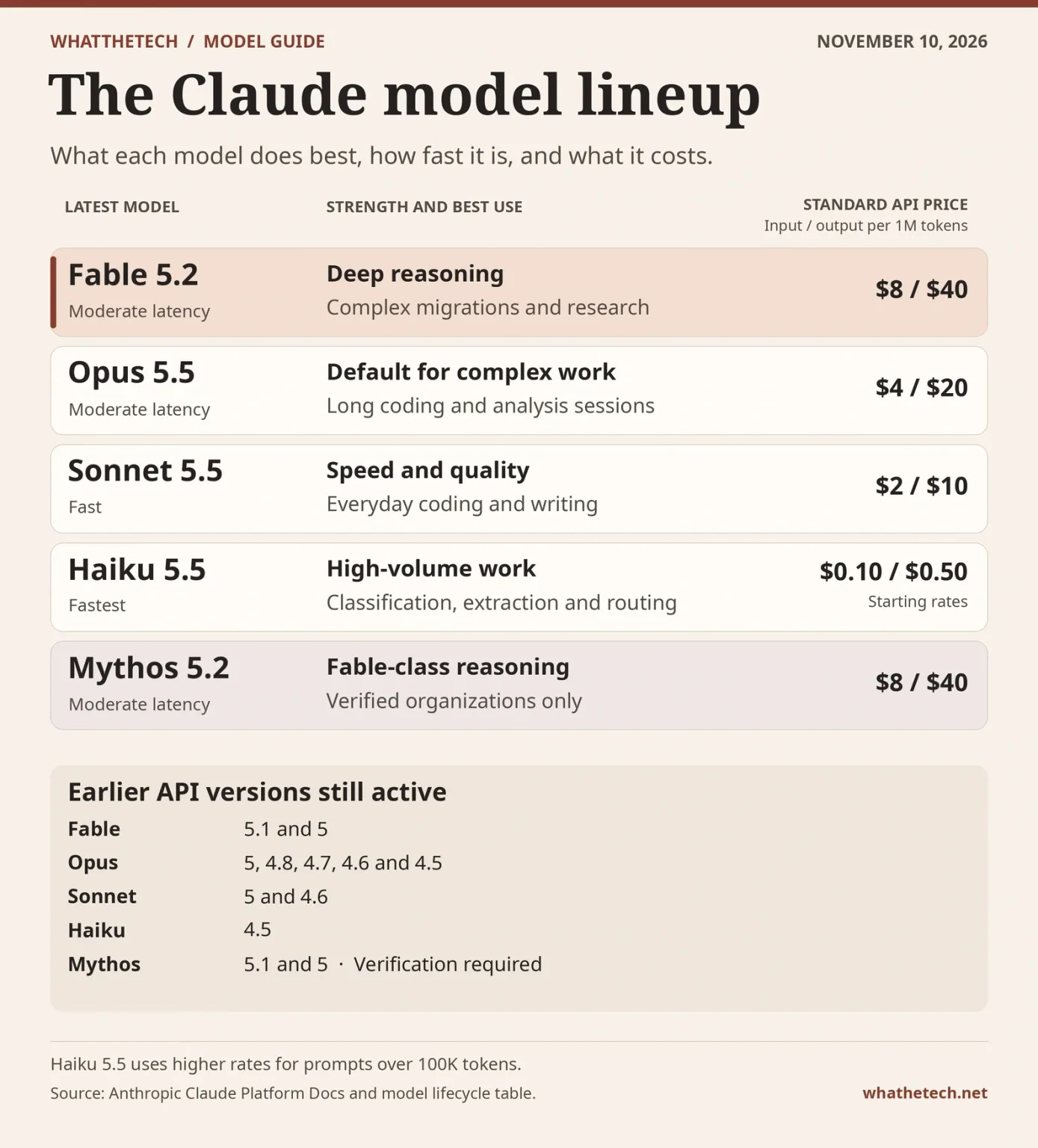
Claude Fable 5.2 is Anthropic’s model for demanding coding, research, and other work that takes several rounds of reasoning and verification. It launched on November 9, 2026, at $8 per million input tokens and $40 per million output tokens on the Claude API. You can select it on eligible paid Claude accounts or call it with the model ID claude-fable-5-2. Anthropic’s launch announcement
For most coding and analysis, start with Opus 5.5. In the single Python migration test below, both models passed all 18 hidden checks on the first attempt, and Opus finished 10 seconds sooner. Fable is worth trying when Opus repeatedly misses a requirement you can check or when the work is expensive to redo.
What Is Claude Fable 5.2, and What Changed From Fable 5.1?
Fable 5.2 is designed for jobs that involve several steps and checks, such as updating a codebase across multiple packages or reconciling conflicting sources for a research report. It has a 1 million-token context window and a 128,000-token maximum output on the Claude API. Opus 5.5 has the same published limits, so file size alone gives you little reason to pay for Fable. Claude Platform model specs
Compared with Fable 5.1, Fable 5.2’s standard API rates are 20% lower. Anthropic reports gains in coding, reasoning, and vision, plus up to 30% faster token generation. The time you actually wait also depends on how much the model reasons, how many tools it calls, and how long its answer is. Anthropic also introduced an optional fast mode that it says can generate tokens up to 2.5 times as fast as standard mode, at double the standard token rates. Anthropic’s release details
Fable 5.2 launched alongside Mythos 5.2. Anthropic says they share the same underlying model. Fable is available to Claude API customers and eligible subscribers, while Mythos access is limited to organizations approved through Anthropic’s verification programs. Anthropic’s availability and migration documentation
Claude Fable 5.2 Pricing and Usage Limits
Claude subscriptions and usage credits
Fable 5.2 is unavailable on Claude Free. Paid-plan access depends on whether Fable is included in your weekly allowance or billed against pay-as-you-go usage credits. The allowance applies across the Fable model family.
Fable usage on Claude plans
| Plan or seat | How Fable is billed |
|---|---|
| Free | Unavailable. |
| Pro and standard Team | Usually billed through enabled usage credits. A temporary launch offer applies through November 16. |
| Max, Ultra, premium Team, and premium legacy seat-based Enterprise | Included up to 50% of your regular weekly allowance. After that, use credits if enabled or switch models. |
| Standard legacy seat-based Enterprise | Uses credits if your organization enables them. |
| Usage-based Enterprise and direct API | Standard usage is billed at API rates. |
Launch offer through November 16, 2026, at 11:59 p.m. PT. Eligible Pro subscribers and standard Team seats can use Fable for up to 50% of their existing weekly allowance without extra charges during the offer. When the cap or deadline is reached, usage credits apply if enabled. Check Settings → Usage for your balance and any eligible reset. Claude plan rules · Launch offer details
API pricing, fast mode, and batch rates
USD rates per million tokens and an example with 100,000 uncached input tokens and 10,000 billable output tokens
| Model or mode | Input | Output | Example cost |
|---|---|---|---|
| Fable 5.2 standard | $8 | $40 | $1.20 |
| Fable 5.2 fast mode | $16 | $80 | $2.40 |
| Fable 5.2 batch | $4 | $20 | $0.60 |
| Fable 5.1 standard | $10 | $50 | $1.50 |
| Opus 5.5 standard | $4 | $20 | $0.60 |
In the standard Fable example, the prompt costs $0.80 and the output costs $0.40. Fast mode makes sense when output generation is what keeps you waiting. Batch pricing works for jobs that can run asynchronously. For a real project, include billed reasoning tokens, retries, and any cache or tool charges when you compare totals. Fable pricing and supported modes · Opus comparison rates · Compare AI API pricing
How to Access Claude Fable 5.2 in Claude, Claude Code, and the API
Claude on the web, desktop, or mobile. Open a chat and select Fable 5.2 in the model picker.
Claude Cowork. Update Claude Desktop, then choose Fable 5.2 for your task.
Claude Code. Update to version 2.1.321 or later. Run
/modeland confirm that the picker shows Fable 5.2.Claude API. Use
claude-fable-5-2in themodelfield of your Messages API request. For a cloud deployment, use the model ID in your provider’s catalog.
If the model is missing, check your subscription, app version, and workspace permissions. If the picker asks you to enable usage credits, check your billing settings before starting a long session. With a third-party Claude Code gateway, confirm the exact model version because the fable alias can resolve differently. Claude Help Center · Claude Code model configuration
Claude Fable 5.2 vs. Opus 5.5: Which Should You Use?
Choose Opus 5.5 for a first pass on most coding and research tasks. Trial Fable 5.2 when Opus at higher effort still fails a defined check, such as maintaining backward compatibility across several packages or tying conflicting findings to their primary sources. For a broader shortlist, use Whathetech’s AI Compare tool.
On the FrontierSWE v2 coding benchmark, Anthropic reported scores of 69.9% for Fable 5.2, 62.3% for Opus 5.5, and 56.3% for Fable 5.1. These are vendor-reported results from a separate evaluation. The smaller test below asks a different question. Does Fable save rework when the assignment is already well specified? Anthropic’s benchmark results and methodology
One Python migration, one run per model
In this recorded test, both models received the same task in separate sessions at medium effort with fast mode off. They had to add a Python settings format while keeping old JSON files readable. The visible tests omitted an edge case. Legacy values stored as "false" and "0" had to survive the migration. The hidden suite covered that requirement.
Results from the Python settings migration
| Measure | Fable 5.2 | Opus 5.5 |
|---|---|---|
| Hidden checks passed | 18 of 18 | 18 of 18 |
| Preserved legacy values | Yes | Yes |
| Time to final answer | 83 seconds | 73 seconds |
| Rework required | None | None |
Both models noticed the legacy values, wrote checks for them, and surfaced errors on unreadable values. Opus was the better fit for this particular task because it passed the same checks and finished sooner. The runs used a subscription, so per-run costs were unavailable. With one run on a small project, the timing is specific to this test.
How to tell if Fable is worth the extra cost
Pick a task that routinely comes back for revision. Write down a pass condition, such as preserving old records, passing regression tests, and providing a rollback step.
Use the same starting files, instructions, and tools in separate sessions. Record the effort setting, time to an acceptable answer, retries, and manual review time.
Compare the total cost of the result you actually accept. At the example rates above, two equivalent Opus attempts cost $1.20 in base token charges, the same as one Fable attempt. Review time and actual token counts can change the decision.
How to Use Claude Fable 5.2 With Claude Skills
A Claude Skill gives either model the same review procedure. For a migration review in Claude Code, create .claude/skills/migration-review/SKILL.md with a name and description. In the instructions, ask Claude to inspect changed files, list each affected legacy format, flag any missing tests, and produce a rollback checklist with file references. Select Fable 5.2 and run /migration-review on a branch with a known regression. Run the same skill with Opus 5.5 if you want to compare how each model applies the procedure. Claude Code Skills documentation
Browse the Whathetech Claude Skills directory for reusable coding, research, and marketing workflows. If you work in the chat app, follow the guide to using Skills in the Claude app.
What to Check Before Upgrading a Fable 5.1 API Integration
Test the model change in staging if your application edits conversation history, switches models mid-session, or uses older tool versions. Fable 5.2 validates preserved thinking blocks against the original conversation on all accounts. Fable 5.1 and Opus 5.5 cannot read Fable 5.2 thinking blocks, so test your fallback with a fresh session or a plain-text handoff. If you use the advisor tool or the older computer_20251124 tool ID, check Anthropic’s compatibility requirements before rollout. Anthropic’s API migration notes
Anthropic documents a 30-day retention requirement for Fable 5.2 on the Claude API, with zero data retention available only when explicitly authorized. Check the policy for your specific deployment before using it with private repositories or customer data. Claude app data follows the applicable app and account terms. Fable 5.2 API data retention
Keep reading


How to Get Your Business on ChatGPT
Claim or add your business in ChatGPT Business Hub, complete verification, and use Insights to see how customers discover your business.


Best Free AI Voice Generators
Start with TTSMaker if you need a downloadable voiceover for a monetized video or client project. Its free web tool offers MP3 and WAV downloads, and its terms...


What Happened to ChatGPT Agent Mode?
OpenAI retired the original ChatGPT Agent Mode and directs users to ChatGPT Work for longer tasks. To have ChatGPT check websites, analyze files or make a sprea...