Tesla’s Flying Roadster: The SpaceX Link and Its Real-World Uses
The aerial demonstration captured attention. The more consequential question is whether aerospace-inspired control can solve useful automotive problems—and do so repeatedly.

In this story
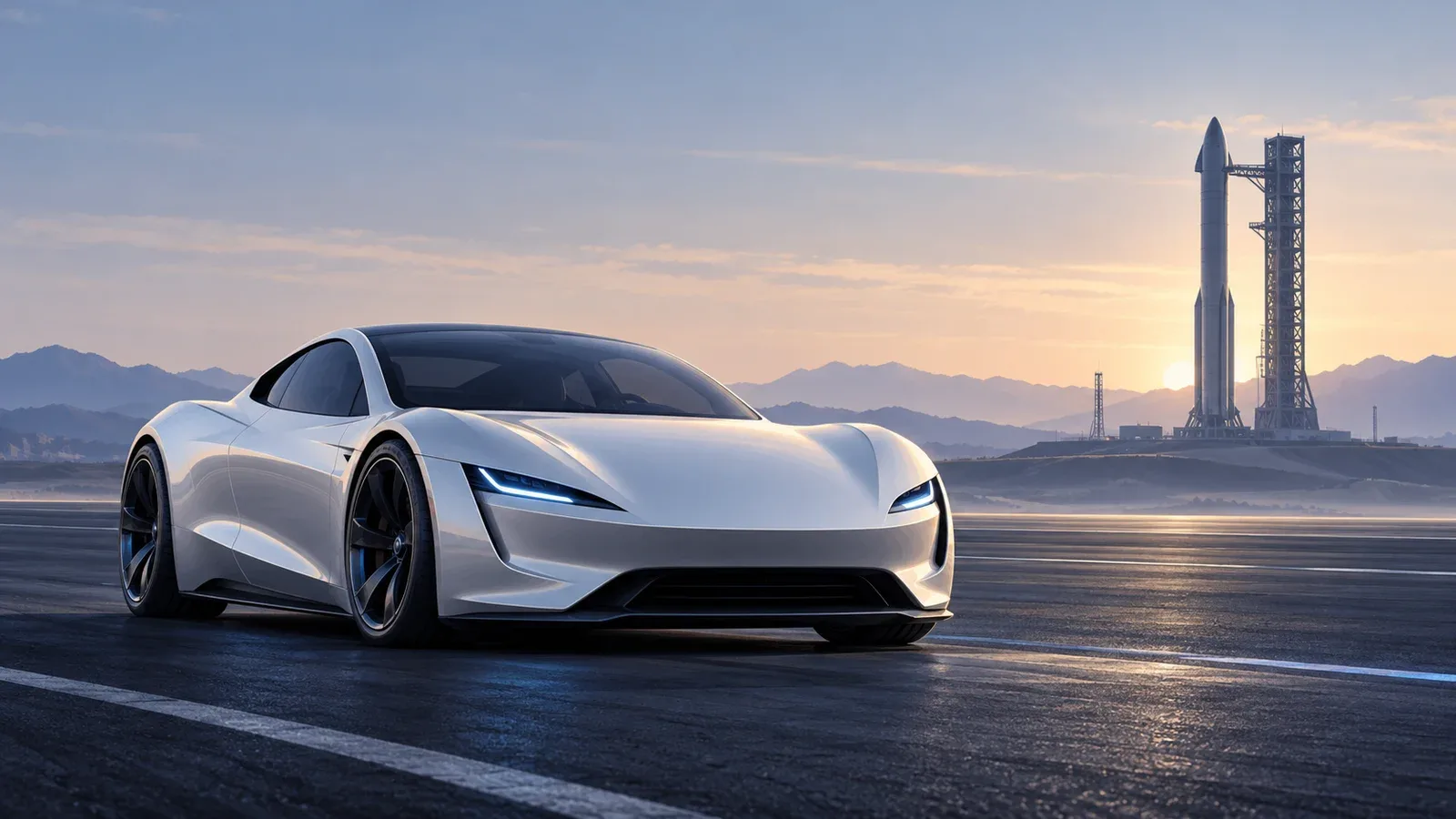
A Tesla Roadster leaving a ramp, rotating through the air and touching down makes an irresistible flying-car headline. The more useful story begins with a familiar driving problem: an electric performance car can generate more power than its tyres can put to work.
At its 15 October demonstration at SpaceX’s McGregor facility in Texas, Tesla presented a redesigned second-generation Roadster developed with SpaceX engineering input. Elon Musk said production was targeted for 2028, according to Reuters’ reporting.
The platform combines two distinct ways to generate force: fans that help hold the car against a surface, and cold-gas thrusters that act directly on the vehicle.
That combination raises a question beyond whether a car can briefly fly: can it deliver useful performance that conventional tyres and motors cannot provide alone?
The answer depends on which Roadster is being discussed—and what survives repeated use.
Three configurations, three different propositions
Tesla has presented Performance, Thrust and Rocket configurations. The company’s product page distinguishes optional equipment and regional availability; reveal coverage reports the following company-stated targets.
| Configuration | Seating and positioning | Principal equipment | Tesla-stated 0–60 mph target |
|---|---|---|---|
| Performance | Two seats; positioned for road use | Fan-assisted downforce and active aerodynamics | Under 1.6 seconds |
| Thrust | Two seats; positioned for track performance | Adds rear acceleration thrusters | Under 0.9 seconds |
| Rocket | One seat; invitation-only; not approved for public-road use | Adds thrusters for airborne manoeuvres | Under 0.59 seconds |
These are manufacturer targets, not independently verified production-car results. Road-use positioning does not establish approval in every jurisdiction. The company-presented 0.81-second run is also distinct from the fastest stated target.
That separation matters: a buyer should not assume that the vehicle they can reserve has every capability shown during the demonstration.
The problem: more power does not always produce more useful performance
Imagine accelerating out of a tight circuit hairpin. The motors can deliver more torque, but the tyres are already using much of their available grip to keep the car turning. The driver must meter the power as the corner opens.
Adding horsepower alone cannot remove that constraint. As Michelin explains, acceleration, braking and directional control depend on tyre grip.
Fan downforce and direct thrust approach this problem differently.
Fans increase tyre loading. Lowering pressure beneath a sufficiently sealed floor can press the vehicle against the surface, including at low speed. This generates downforce without equivalent ballast, although the equipment itself adds mass.
Thrusters provide another force source. A suitably directed gas jet can contribute force without transmitting that particular force through the tyre contact patches.
The complete vehicle remains dynamically coupled to its tyres, suspension and road surface. Neither system removes those relationships.
The opportunity is therefore to expand usable performance. The test is whether the benefit outweighs added weight, energy demand, maintenance and complexity.
What SpaceX contributes—and why these are different landing systems
The resemblance to a rocket landing is understandable: a vehicle changes orientation and uses thrust while returning to the ground.
SpaceX, however, uses several different control systems. Its Falcon Payload User’s Guide identifies nitrogen-gas thrusters for first-stage orientation control during recovery. They are separate from the combustion-powered Merlin engines involved in landing burns. Starship’s SN15 prototype used reignited Raptor engines for its landing flip, as SpaceX documented.
The Roadster connection is aerospace experience applied to automotive thrust control. It does not establish identical engines or copied flight software.
Cold-gas propulsion releases pressurised gas through nozzles without combustion. NASA’s review describes its suitability for precise manoeuvring and its impulse limitations.
Pressure vessels can provide lightweight gas storage. The correct term, used by NASA, is composite overwrapped pressure vessel, or COPV. Carbon fibre can form part of the reinforcing material.
The useful principle is straightforward: a gas jet supplies a controlled push, but its usable supply is finite.
Tesla’s patent points to the challenge beneath the spectacle
Tesla’s patent US12377920B1, Adaptive Vehicle Aerodynamics for Downforce, was granted on 5 August 2025. It describes fans and selectively deployable skirts that create low-pressure regions beneath a vehicle.
The patent text also discusses adapting operation to changing ground clearance and driving conditions.
A patent does not prove that every described feature is installed in the Roadster or ready for production. But it identifies a practical problem: maintaining useful downforce as the relationship between the floor and road changes.
Holding a vehicle against a smooth demonstration surface is one task. Managing a braking zone, an uneven straight and a corner is another.
That transition is where a promising aerodynamic idea must become a predictable driving system.
Three potential customers—and the problems they would pay to solve
These are potential applications, not evidence of Tesla contracts or proven demand.
| Potential customer | Problem to solve | Evidence that would establish value |
|---|---|---|
| Track-car owner or time-attack entrant | Available motor performance exceeds usable grip in parts of a lap | Independent sector times, repeatable laps and recovery logs |
| Professional demonstration or stunt operator | Producing unusual vehicle motion predictably | Repeatability, operating limits and cost per completed performance |
| Engineering or component customer | Developing reliable control using several force sources | Durability, integration costs and documented advantages over alternatives |
Track performance: measure the session, not just the launch
A tight circuit offers a logical test. Fan downforce could help make more acceleration or braking capability usable at low speed. Thrusters could provide an additional contribution, depending on their direction, duration and permitted use.
Reviewers should separate these effects through comparable tests with each relevant system enabled and disabled.
A faster launch does not automatically establish a faster lap. A single fast lap does not establish a better twenty-minute session.
Pressure vessels, valves and associated equipment remain aboard when the gas supply is depleted. Fans consume energy, while greater performance creates demands on tyres and other components.
The customer benefit would be more useful performance across the intended session, with acceptable preparation and recovery time.
Professional demonstrations: predictability is the product
A stunt operator may value a manoeuvre that a commuting driver would never need.
The task is producing that movement repeatedly in a controlled environment. Preparation, staffing, exclusion distances, noise and the ability to abandon a manoeuvre all affect its usefulness.
A single-seat configuration could suit some applications while limiting passenger experiences. Extensive preparation might be acceptable for an occasional production but unsuitable for repeated daily performances.
The commercial question is concrete: what does each completed manoeuvre cost, including setup, recovery and maintenance?
A livestream establishes attention. An operating record would establish whether that attention can support a repeatable service.
Component customers: the useful output could be inside the car
An extreme vehicle can expose valuable problems in valves, actuators, pressure management and control integration.
Tesla has also linked Roadster wing actuation with its Optimus actuator technology in published reveal messaging. That is an example of reported technology reuse, rather than proof that the Roadster has already created cost savings or reliability improvements elsewhere.
There is a relevant business comparison: McMurtry’s Applied Technology offering markets fan-downforce, battery and powertrain expertise for tailored applications.
For Tesla and SpaceX, wider engineering value remains plausible. It becomes measurable when a component, method or capability is reused and improves a defined task.
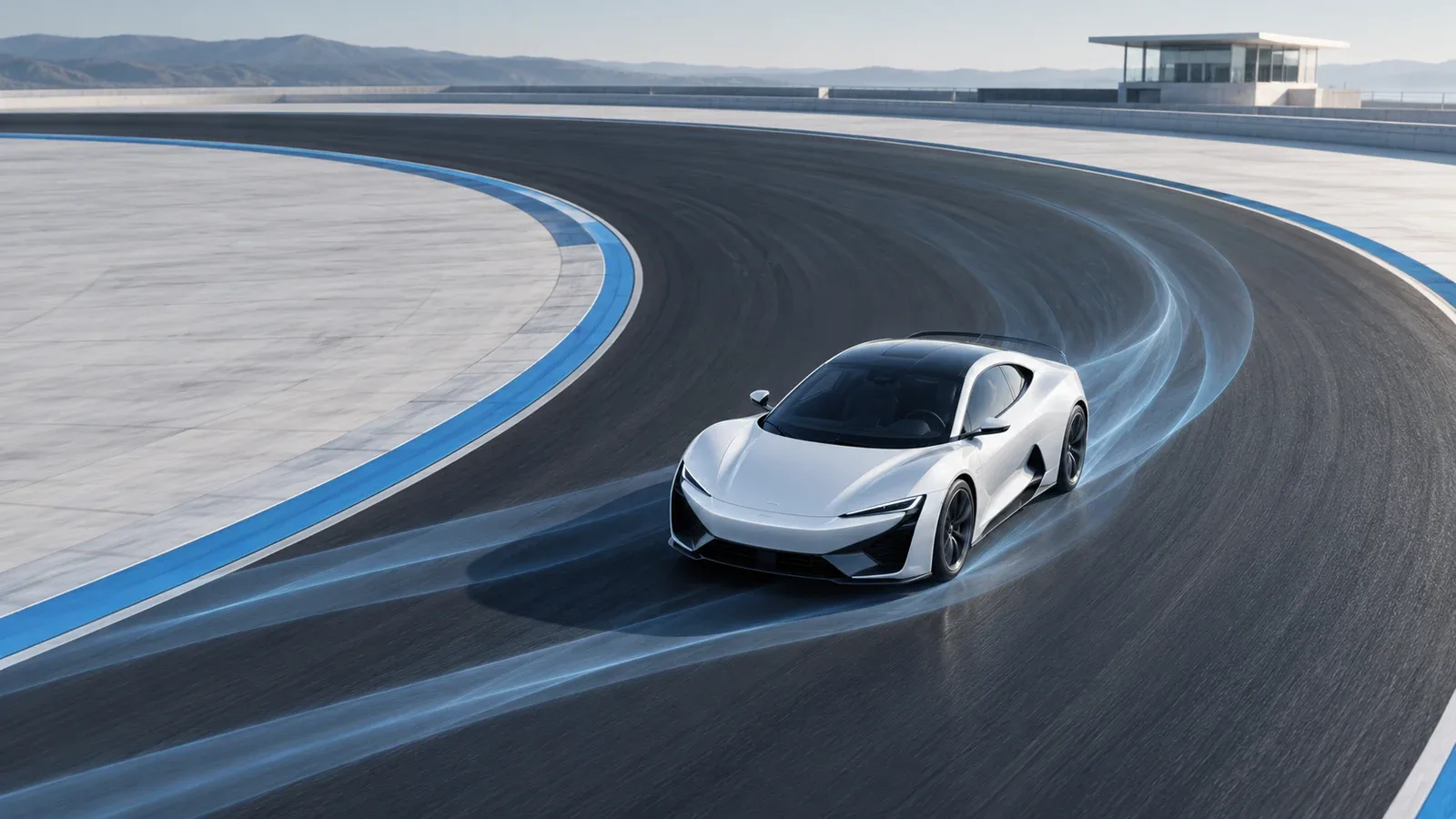
AI-generated conceptual illustration of controlled track testing. It does not depict a measured Roadster result or verified airflow.
The new perspective: available performance is a changing resource
An electric-car review already considers battery charge and temperature. A stored-gas vehicle adds another state: remaining usable thrust.
A driver could have substantial battery charge while lacking enough gas to repeat the headline manoeuvre.
NASA defines total impulse as force delivered over time. Peak thrust alone does not establish endurance.
For illustration, a hypothetical 2,000-kilogram vehicle needs approximately 19.6 kilonewtons of upward thrust to balance its weight near Earth’s surface. Maintaining that force for five seconds requires approximately 98 kilonewton-seconds of upward impulse.
This is basic physics, not a Roadster mass specification or flight-duration estimate. It assumes approximately constant mass and excludes the additional demands of climbing, correcting motion and slowing a descent.
Direction matters too: adding together nozzle ratings does not establish that the resulting force is available upward or forward.
If manoeuvres share a gas supply, spending it on one function can constrain another. The architecture and control strategy determine that relationship; the demonstration does not disclose enough to establish it across configurations.
For airborne operation, a fundamental question is how sufficient control is retained throughout the permitted manoeuvre, including touchdown.
A useful customer display would communicate currently available capability—not merely tank pressure.
McMurtry shows what production progress looks like
McMurtry demonstrated its Spéirling prototype driving upside down in 2025. Its July 2026 production-form announcement describes improvements involving fan durability, cooling, skirt travel and service access, including cleaning fan filters.
These are manufacturer statements, not independent confirmation of every outcome. Nevertheless, they identify the kind of work that turns dramatic performance into customer operation.
The questions for Tesla are equally practical. How often do skirts and filters need attention? What happens as a seal deteriorates? How does the vehicle respond when an auxiliary system loses capability?
Those answers may prove more commercially significant than another aerial trick.
Claims about everyday emergency braking or collision avoidance would require separate evidence. A system intended for traffic must account for depleted gas, faults, uncertain surfaces and nearby people. The reveal does not establish that benefit.
What to watch next: five milestones that would change the assessment
1. Independent tests with disclosed starting conditions
Look for vehicle mass, tyre specification, surface preparation, battery charge, initial gas state and timing method, including whether rollout is used.
What changes: a company claim becomes a result another team can reproduce.
2. Repeated-run performance and recovery
Compare the fifth and tenth attempt with the first. Measure replenishment time, energy consumption, downtime and any reduction in capability.
What changes: isolated performance becomes evidence of a usable operating cycle.
3. Predictable behaviour through transitions and faults
Testing should address changing surfaces, reduced auxiliary capability and the limits within which airborne manoeuvres are permitted.
What changes: the assessment expands from successful demonstrations to controlled operation across defined conditions.
4. Clear production specifications and ownership terms
Watch for final hardware, configuration differences, permitted uses, maintenance requirements and warranty coverage.
What changes: customers can compare what they can obtain with what they watched.
5. Documented customer or engineering value
Look for a measurable improvement in a lap, a professional performance or a component application, including operating costs.
What changes: technical novelty gains evidence of a market beyond the reveal.
Why the audacious bet still matters
There is a legitimate argument for building extreme machines before their everyday usefulness is obvious.
A difficult prototype can force teams to confront packaging, control and durability problems that ordinary development programmes would not encounter in the same combination. Even if the complete vehicle remains a niche product, reusable components and documented learning could create value elsewhere.
That possibility deserves investigation. It should not be treated as an automatic return on every ambitious project.
McMurtry’s work also shows that this experimentation extends beyond one founder or company. The useful competition is between engineering approaches—and the evidence each produces.
The strongest case for the Roadster is therefore broader than either a commuting vehicle or a publicity stunt. It could become a specialist product and a platform for developing capabilities that other customers eventually use.
To establish that case, Tesla needs to show what the experiment delivers: repeatable performance, workable ownership and identifiable engineering benefits.
SpaceX provides a useful commercial analogy. Landing matters because it enables the next mission. For the Roadster, the next revealing demonstration would show the complete cycle: preparation, performance, touchdown, inspection, replenishment—and another run.
Methodology: This is public-source news analysis, not an independent vehicle test. Manufacturer targets are attributed as claims. Potential applications, evaluation criteria and the numerical illustration are analysis rather than measured Roadster outcomes.
Company context: Explore Tesla’s business model, products and company history.
Frequently Asked Questions
When will the new Tesla Roadster go into production?
At its 15 October demonstration at SpaceX’s McGregor facility in Texas, Tesla presented a redesigned second-generation Roadster developed with SpaceX engineering input. Elon Musk said production was targeted for 2028, according to Reuters’ reporting.
How do the Roadster’s suction fans work?
Lowering pressure beneath a sufficiently sealed floor can press the vehicle against the surface, including at low speed. This generates downforce without equivalent ballast, although the equipment itself adds mass.
What are cold-gas thrusters?
Cold-gas propulsion releases pressurised gas through nozzles without combustion. A suitably directed gas jet can contribute force without transmitting that particular force through the tyre contact patches.
Are Tesla’s 0–60 mph times for the Roadster verified?
These are manufacturer targets, not independently verified production-car results. Road-use positioning does not establish approval in every jurisdiction.
Does the Roadster use SpaceX rocket engines?
The Roadster connection is aerospace experience applied to automotive thrust control. It does not establish identical engines or copied flight software.
Keep reading
AI Agent Companies in 2026: 24 Companies, Platforms, and Startups to Know
Last updated: August 20, 2026 AI agent companies now include everything from cloud platforms that help developers build agents to specialized companies selli...